Soldiers', Sailors', Marines', Coast Guard and Airmen's Club
283 Lexington Avenue | also 281 Lexington Avenue | Murray Hill | built 1915
Open on the map12 entries

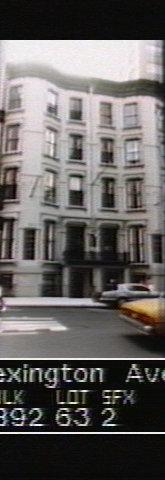
The city photographed every building for its tax records around 1940 and again in the 1980s. NYC Municipal Archives.
Written with AI from the source each entry cites, then fact-checked.
- 1882
Charles Buek & Co. completes a row of six matching brownstones at 279 to 289 Lexington Avenue
Charles Buek & Co., acting as both developer and architect, built a speculative row of six matching houses at 279 through 289 Lexington Avenue in 1882. The four-story brownstones were designed as three pairs, with side-by-side entrances flanked by sharply angled three-sided bays and Eastlake-style incised carving. They sold quickly to well-off professionals; No. 285 went for $37,000 and the corner house at No. 279 for $50,500.
Source: Daytonian in Manhattan
- 1907
Dr. Royal Whitman buys No. 283 Lexington Avenue, and an architect files plans to remodel it
By 1891 No. 283 was being run as a boarding house, advertising furnished bachelor apartments with bath and attendance. In April 1907 the wealthy Dr. Royal Whitman bought the house, and three months later the architect S. S. Gage filed plans to remodel it for him. Two decades later the Whitman home was the building chosen for a servicemen's club.
Source: Daytonian in Manhattan
- 1927
The Soldiers' and Sailors' Club formally opens its clubhouse at 283 Lexington Avenue
After a campaign to raise $350,000, the club moved from 261 Madison Avenue into the former Whitman house, and the new clubhouse formally opened on November 17, 1927. Property and renovations cost $300,000, and donors furnished bedrooms as memorials, one of them for the Unknown Soldier. Servicemen paid five cents a night for a room, and the club's dog mascot, Chubby, moved in with them.
Source: Daytonian in Manhattan
- 1927
The club holds a Christmas Eve memorial service for the 40 men lost on submarine S-4
A month after the clubhouse opened, the Navy submarine S-4 was rammed off Cape Cod by the Coast Guard destroyer Paulding, and all 40 men aboard died after rescue efforts failed. On Christmas Eve the club held a memorial service for the crew. Navy Chaplain Stanton W. Salisbury, who came from the Brooklyn Navy Yard, called the crew's death a supreme sacrifice.
Source: Daytonian in Manhattan
- 1928
The John Ericsson Society gives the club a radio set, and servicemen broadcast from the house
The John Ericsson Society gave the club a $450 radio set on April 21, 1928. General Peter E. Traub presented it to Francis Rogers at a ceremony attended by a large detachment of wounded Marines from Nicaragua. For years afterward, servicemen at the club broadcast radio programs from the building, notably for occasions such as Memorial Day.
Source: Daytonian in Manhattan
- 1928
John D. Rockefeller and Edward S. Harkness each give the club $10,000
John D. Rockefeller and Edward S. Harkness each wrote the club a $10,000 check on May 7, 1928. Gifts from Manhattan millionaires arrived now and then, alongside benefit events held through the following decade to offset the club's costs. Its popularity was already straining its space and budget.
Source: Daytonian in Manhattan
- 1935
The club's guest count grows from 2,000 servicemen in 1926 to more than 83,000 in 1935
In 1926 the club had seen 2,000 servicemen; by 1935 more than 83,000 passed through. That year it reported providing beds to over 17,000 soldiers and sailors and serving 54,000 in its canteen. A room, which had cost five cents when the clubhouse opened, now went for 50 cents.
Source: Daytonian in Manhattan
- 1940
A policeman finds three soldiers who were turned away sleeping in a doorway beside the club
A policeman making his rounds just after sunrise on October 7, 1940 found three U.S. soldiers asleep in a doorway beside the clubhouse; they had been turned away the night before. They were brought inside for hot showers and coffee. Director Harold E. Nicolai explained that the club had beds for only 75, though mattresses on a recreation-room floor raised the count to 105 that evening, and 275 men were still turned away.
Source: Daytonian in Manhattan
- 1942
The club opens an expansion into No. 285 Lexington Avenue with room for 150 men
Helped mostly by an $84,000 gift from the USO, the club took in the house next door at No. 285, and the expanded clubhouse opened on June 17, 1942. More than 1,200 people attended, and The New York Times quipped that generals nearly matched enlisted men in number. The enlarged club had beds for 150 men, three floors of dormitories with gray marble showers, and a rear garden given by two garden clubs.
Source: Daytonian in Manhattan
- 1944
More than 1,000 servicemen eat Thanksgiving dinner at the club, and weekly wartime dances continue
More than 1,000 servicemen sat down to Thanksgiving dinner at the club in 1944, and a formal New Year's Eve dance followed. Dances were held every week through the war. Dancing classes were added in 1945 for the young men who had never learned.
Source: Daytonian in Manhattan
- 2018
The Soldiers', Sailors', Marines', Coast Guard and Airmen's Club closes
The club closed on December 31, 2018. In its last years it served roughly 15,000 military personnel, veterans and relatives each year while running an annual deficit near $350,000. Supported only by guest proceeds and private donations, it had accommodated more than 2.5 million members of the U.S. military and their families.
Source: Wikipedia
- 2025
The Sisters of Life buy the former club building for $7.5 million
The Sisters of Life bought the building in 2025 for $7.5 million, several years after the club closed on December 31, 2018. By then it was a 79-bed facility with a library, two large event rooms and a dining room, its walls covered in U.S. military memorabilia, especially from the two World Wars.
“In 2025, the building was sold to the Sisters of Life for $7.5 million.”
Source: Wikipedia
Further reading
- Soldiers', Sailors', Marines', Coast Guard and Airmen's ClubWikipedia
- The Soldiers and Sailors' Clubhouse -- Nos. 283-285 Lexington AvenueDaytonian in Manhattan
Nearby
- Sniffen Court150 East 36th Street | 4 entries
- 152 East 38th Street4 entries
- McCafferty House146 East 38th Street | 4 entries
- Sarge's Delicatessen & Diner548 3rd Avenue | 5 entries
- James F. D. Lanier House123 East 35th Street | 4 entries
- 55 Park Avenue2 entries