Henry Elsworth House
29 Vandam Street | Hudson Square | built 1834
Open on the map6 entries

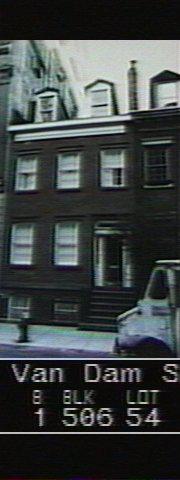
The city photographed every building for its tax records around 1940 and again in the 1980s. NYC Municipal Archives.
Written with AI from the source each entry cites, then fact-checked.
- 1854
Cabinetmaker Dwight Bishop advertises the second floor with gas and Croton water
By 1851 the house was home to Dwight Bishop, a furniture maker who had opened his shop in 1825 and worked from a five-story factory on Hudson Street. In November 1854 he advertised a suite of rooms on the entire second floor, furnished or not, with board if wanted. The listing promised gas, a bath and Croton water, a sign the house had been fitted with indoor plumbing after the city's reservoirs opened in 1842.
Source: Daytonian in Manhattan
- 1879
Coal dealers George and David Nevin move in, one a Gettysburg brigade commander
In 1879 the Nevin family took the house. George P. Nevin and his brother David, both from York, Pennsylvania, ran coal yards in Manhattan. During the Civil War David had raised Company D of the 62nd New York, risen to colonel and led the Third Brigade of the Sixth Corps at Gettysburg. Death came quickly to the household: George's wife Charlotte died in November 1879 and David followed on October 24, 1880, aged 52.
Source: Daytonian in Manhattan
- 1901
Dr. Frank Jellecker leaves home on a hot night and is found dead in a West Street hotel
Frank A. Jellecker, a 32-year-old physician who lived here with his father and sisters, went out on the evening of July 2, 1901 to make professional calls. He never came back; police later told the family he had been found dead at a hotel at 190 West Street, where he had registered as Frank Jones. He was one of 113 people in Manhattan who died of heat that day, and his sisters could not explain why he was there.
Source: Daytonian in Manhattan
- 1913
Magazine illustrator Albert Schultz, a boarder, is found dead after a postcard from his daughter
By 1911 the house was a rooming house run by Margaret Carpenter, whose boarders included Albert B. Schultz, an artist who drew for Puck and The Motion Picture Story Magazine. A widower, he had placed his ten-year-old daughter Anna in a Manhattan children's home. When Anna's postcard reached the house on November 18, Carpenter realized she had not seen him since Friday, and the forced door revealed that he had died; the New York Times reported a suicide.
Source: Daytonian in Manhattan
- 1919
William Coffin buys fifteen Vandam and King Street houses from Trinity Church
As Trinity Church began selling its Manhattan holdings after World War I, the Real Estate Record & Guide reported on August 9, 1919 that William S. Coffin had bought the church's houses on Vandam Street, numbers 7 to 29, and King Street, numbers 41-45, fifteen dwellings in all. He had already acquired fourteen similar houses on Charlton Street. Margaret Carpenter kept running No. 29 as a boarding house until Coffin sold it in 1923.
Source: Daytonian in Manhattan
- 1966
The Landmarks Commission names No. 29 among Vandam Street's close-to-original Federal houses
When the Landmarks Preservation Commission designated the Charlton-King-Vandam Historic District on August 16, 1966, its report singled out numbers 23, 25, 27 and 29 Vandam Street as still close to their original state. It praised their pitched roofs, dormers, delicate doorways and ironwork as representative of the Federal style.
Further reading
- The Henry Elsworth House - 29 Vandam StreetDaytonian in Manhattan
Nearby
- Paul Taylor House27 Vandam Street | 4 entries
- 25 Vandam Street1 entry
- Horace Whitehorn House23 Vandam Street | 4 entries
- Israel Clark House21 Vandam Street | 4 entries
- Michael Eagan House19 Vandam Street | 3 entries
- Elisabeth Irwin High School40 Charlton Street | 4 entries