293 East 10th Street
East Village | built 1846
Open on the map3 entries

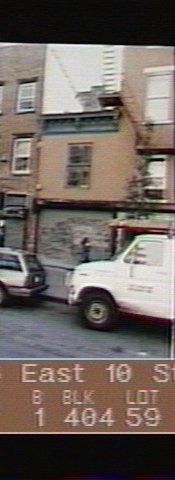
The city photographed every building for its tax records around 1940 and again in the 1980s. NYC Municipal Archives.
Written with AI from the source each entry cites, then fact-checked.
- 1846
Joseph Trench, attributed architect of 293 to 299 East 10th Street, is an early Italianate pioneer
The row of houses at 293 to 299 East 10th Street is attributed to Joseph Trench, who first appeared in city directories as an architect in 1837 and took on Jasper Cropsey, later a Hudson River School painter, as an apprentice. In 1842 he brought John Butler Snook into the firm. His office designed the A. T. Stewart Store of 1845-46, widely considered the first New York building in the Italianate style, and Trench left for California in the early 1850s.
“Trench hired aspiring architect Jasper Francis Cropsey—who would later become an important painter in the Hudson River School—as an apprentice and draftsman.”
- 1846
Butcher and grocer Joshua Varian buys the new row house at 293 East 10th Street
Joshua M. Varian, an American-born butcher and grocer, was the first owner of 293 East 10th Street. The Landmarks Preservation Commission notes that the first residents of these Trench-built houses, among them a butcher, a ship joiner and a jeweler, were not the elite the developers had probably hoped to attract. Like its neighbors up to no. 299, it originally had a short attic story under a peaked roof, raised in the late 19th century.
- 1890
Charles J. Smith, whose name is on the cornice, owns 293 East 10th Street when it is a hotel
From the 1890s into the 20th century the building belonged to Charles J. Smith, whose name is still lettered on the cornice. During his ownership it served as a hotel. After a sale to a new owner it was converted back to a store with several apartments, and the facade still shows its late 19th-century Queen Anne cornice, added when a half story was raised on top.
Further reading
- 293 East 10th StreetVillage Preservation: East Village Building Blocks
Nearby
- 295 East 10th Street2 entries
- East Village Tots297 East 10th Street | 3 entries
- James Scott Aspinwall House299 East 10th Street | 3 entries
- 301 East 10th Street2 entries
- 303 East 10th Street2 entries
- William F. Pinchbeck House305 East 10th Street | 4 entries