Church of the Holy Apostles
296 9th Avenue | also 298 9th Avenue | Chelsea | built 1848
Open on the map6 entries

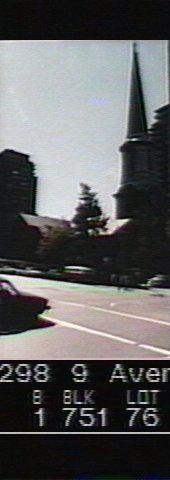
The city photographed every building for its tax records around 1940 and again in the 1980s. NYC Municipal Archives.
Written with AI from the source each entry cites, then fact-checked.
- 1848
Minard Lafever completes the Italianate Church of the Holy Apostles
Trinity Church founds Holy Apostles in 1844 as an outreach chapel for workers along the Hudson River waterfront, and architect Minard Lafever's Italianate design is built out between 1845 and 1848. Later architects extend the sanctuary, first with a deeper chancel and then into a full cross shape with transepts. It remains the only Lafever church still standing in Manhattan.
Source: Wikipedia
- 1966
The city designates Holy Apostles a landmark
New York City's Landmarks Preservation Commission designates the Church of the Holy Apostles an individual landmark in 1966, protecting Minard Lafever's Italianate design and its geometric stained-glass windows by William Jay Bolton. The church is added to the National Register of Historic Places six years later.
Source: Wikipedia
- 1969
Holy Apostles opens its doors to the new gay liberation groups
Starting in August 1969, weeks after Stonewall, the church became a regular meeting place for gay organizations. The West Side Discussion Group, the Gay Liberation Front, the Gay Activists Alliance, Gay Youth, the Church of the Beloved Disciple and the Metropolitan Community Church of New York all met here between 1969 and 1974. Congregation Beit Simchat Torah, the gay and lesbian synagogue, held Friday services here from February 1973.
Source: NYC LGBT Historic Sites Project
- 1977
Bishop Paul Moore ordains Ellen Barrett, an openly lesbian priest
In 1977, at Holy Apostles, Episcopal Bishop Paul Moore ordained Ellen M. Barrett as a priest. Barrett was openly lesbian. The church continued to welcome LGBT congregations: Beit Simchat Torah, which had left for Westbeth in 1975, returned to worship in the sanctuary from 1998 to 2016.
Source: NYC LGBT Historic Sites Project
- 1982
The congregation starts the Holy Apostles Soup Kitchen
In 1982 the parish began the Holy Apostles Soup Kitchen to feed poor and homeless New Yorkers, and it has kept serving meals ever since. The sanctuary itself, a city landmark since 1966, was badly damaged by a fire in 1990 that destroyed some of its stained-glass windows.
Source: Wikipedia
- 1990
Fire heavily damages the church sanctuary
A fire severely damages the Holy Apostles sanctuary in 1990, destroying some of its historic stained-glass windows. The congregation undertakes a restoration, overseen by Ed Kamper, that finishes in 1994 without interrupting the parish's soup kitchen and other social services. The rebuilt sanctuary reopens for worship alongside those ongoing outreach programs.
Source: Wikipedia
Further reading
Nearby
- Hopper-Gibbons House339 West 29th Street | 4 entries
- Hotel Irvin308 West 30th Street | 4 entries
- Chelsea Recreation Center430 West 25th Street | 4 entries
- London Terrace405 West 23rd Street | 8 entries
- Marquee New York289 10th Avenue | 3 entries
- R. C. Williams Warehouse259 10th Avenue | 3 entries