298 Grand Street
also 300 Grand Street | Lower East Side | built 1900
Open on the map5 entries

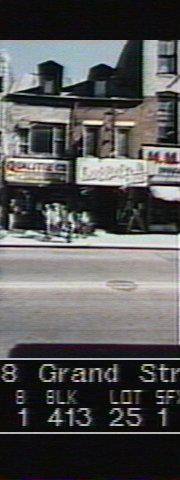
The city photographed every building for its tax records around 1940 and again in the 1980s. NYC Municipal Archives.
Written with AI from the source each entry cites, then fact-checked.
- 1850
Modest Federal houses at 298 and 300 Grand Street shelter shopkeepers above their stores
Nos. 298 and 300 Grand Street began as a matched pair of brick Federal houses from the 1820s or 1830s, two and a half stories each with a dormer, built for working families. Their ground floors soon turned into shops. By 1850 bookbinder Eber T. Peacock, who had earlier worked from Broad Street, had moved into No. 298 and lived upstairs, staying until shortly before the Civil War.
Source: Daytonian in Manhattan
- 1872
A visitor leaves 300 Grand Street with William Merrick's gold watch and chain
On a Friday night in 1872, William H. Merrick, who was established at No. 300, had a woman named Ellen Josephs in his rooms. She left with his gold watch and chain, valued at $185. According to the account, Merrick had to choose between going to the police and keeping quiet to avoid explaining why she had been there.
Source: Daytonian in Manhattan
- 1885
Theodor Lohr sells and makes banjos, guitars and violins at No. 298
German immigrant Theodor Lohr settled his instrument business at 298 Grand Street, where he appears in the 1885 American Musical Directory as an importer. He made most of his own violins, banjos, harmonicas and guitars with one workman and two boys, yet kept 150 dozen banjos in stock. Around 1900 he also published Yiddish music, and a 1901 ad pushed zithers, mandolins and guitars.
Source: Daytonian in Manhattan
- 1894
A police court judge lets a jilted woman keep her engagement ring
Frederick Kall, who lived upstairs at No. 300, broke off his engagement to Hetty Sonberg after she had nursed him through typhoid fever. When she asked for the diamond ring he had given her in 1892, he refused, and he later told Judge Taintor that she had left him alone for two days to go to a picnic. The judge sided with Hetty and let her keep the ring as a souvenir.
Source: Daytonian in Manhattan
- 1900
A husband eats his wife's stock of hats and stuffed birds in her millinery shop
On Independence Day 1900, ice cream dealer Louis Goldstein walked into his wife's millinery shop on the ground floor and began wrecking her stock by eating it. The New York Times said he lunched on a pair of stuffed birds and finished with part of a spring bonnet, while threatening her. He was arrested on a charge of threatening to kill her.
Source: Daytonian in Manhattan
Further reading
- Two Abused Federal Survivors at Nos. 298-300 Grand StreetDaytonian in Manhattan
Nearby
- Dirt Candy81 Orchard Street | 7 entries
- Edward Ridley & Sons Department Store Buildings315 Grand Street | 3 entries
- Edward Ridley & Sons Department Store Buildings319 Grand Street | 4 entries
- M. Rosendorff & Son Building277 Grand Street | 7 entries
- Kehila Kedosha Janina Synagogue280 Broome Street | 8 entries
- The Garfield104 Forsyth Street | 3 entries