Washington Square Arch
3 Washington Square North | Greenwich Village | built 2013
Open on the map13 entries

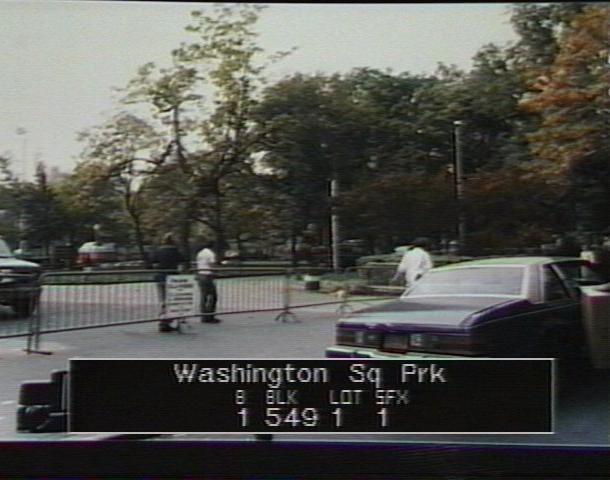
The city photographed every building for its tax records around 1940 and again in the 1980s. NYC Municipal Archives.
Written with AI from the source each entry cites, then fact-checked.
- 1887
William Rhinelander Stewart recruits Stanford White to direct the Washington centennial celebration
In 1887, with several groups already planning festivities for the 1889 centennial of Washington's inauguration, real-estate heir William Rhinelander Stewart came up with a plan of his own. He asked architect Stanford White to run the commemoration, and the two quickly settled on a temporary triumphal arch. That same year London marked Queen Victoria's fiftieth year on the throne with temporary triumphal arches. No stone arch had yet been built anywhere in the United States.
Source: Daytonian in Manhattan
- 1889
Freemasons carry Washington's own inaugural Bible through the temporary arch
During the 1889 centennial parade, Freemasons from St. John's Lodge No. 1 marched under the plaster-and-wood arch on Fifth Avenue carrying the George Washington Inaugural Bible. The lodge brought the same Bible back when the cornerstone of the permanent marble arch was laid.
“Freemasons from St. John's Lodge No. 1 lead a procession through the arch with the George Washington Inaugural Bible for the Centennial Parade of Washington's Inauguration in 1889.”
Source: Wikipedia
- 1889
A temporary wood-and-plaster arch spans Fifth Avenue for the centennial of Washington's inauguration
William Rhinelander Stewart, who lived on the square, campaigned for a triumphal arch to mark the 100th anniversary of Washington's inauguration, and his neighbors paid for it. Stanford White of McKim, Mead and White designed the temporary structure of wood and plaster, which crossed Fifth Avenue just north of Washington Square Park. It proved so popular that a campaign for a permanent version soon began.
Source: Village Preservation
- 1890
Digging for the marble arch's foundations turns up coffins, skeletons and 1803 gravestones
Ground was broken on April 30, 1890, in a quiet ceremony. Within about two weeks the laborers were uncovering skeletons, headstones and coffins, and curious crowds gathered at the site. Stanford White ordered work paused until the scene could be sketched. Two stones dated 1803 showed that the diggers had hit an old German burying ground, buried under eight feet of new soil during the leveling of the square. The remains were reburied and construction resumed above them.
Source: Daytonian in Manhattan
- 1890
Stanford White designs a permanent Tuckahoe marble arch, set slightly south inside the park
Construction of the permanent arch was underway by 1890, again to a design by Stanford White and again with fundraising among neighbors. White used Tuckahoe marble for the new arch, which is 30 feet wide, and it was shifted slightly south to stand inside the park boundary. White also designed Judson Memorial Church at the park's south end.
Source: Village Preservation
- 1895
Sculptor MacMonnies models the arch's Peace on his wife and its War on Stanford White's wife
When the finished arch was dedicated on May 4, 1895, its carved ornament was mostly the design of Frederick MacMonnies, executed by the Piccirilli studio, with the large marble eagles by Philip Martiny. MacMonnies used his own wife's face for the figure of Peace and Bessie White's for War. White and builder David King gave their services free, yet the arch still cost close to $134,000.
Source: Daytonian in Manhattan
- 1895
The Washington Square Arch is formally dedicated
The marble arch was dedicated on May 4, 1895, and has been the visual anchor of Washington Square Park since. The two large Washington figures on the north face were not yet in place and were added in 1916 and 1918. It replaced the temporary plaster arch of 1889, which had proved popular enough to prompt a permanent marble version.
Source: washingtonsqpark.org
- 1917
Marcel Duchamp, John Sloan and friends climb the arch and declare the Free and Independent Republic of Washington Square
Poet Gertrude Drick, painters John Sloan and Marcel Duchamp, and three Provincetown Playhouse actors got in through an unlocked door and climbed the spiral stairs on a snowy day. Drick read out a declaration of independence, proclaiming the Free and Independent Republic of Washington Square. On the roof the group laid out blankets, hung lanterns, tied red balloons to the parapet, drank tea and fired cap pistols until dawn. Sloan later etched the scene as Arch Conspirators.
Source: Village Preservation
- 1918
Two sculptures of Washington, by Hermon MacNeil and Alexander Stirling Calder, are added to the arch's north face
Washington as Commander-in-Chief, with Fame and Valor, by Hermon A. MacNeil was made between 1914 and 1916, and Washington as President, with Wisdom and Justice, by Alexander Stirling Calder followed in 1917 and 1918. In Calder's figure a hand holds a book carrying the Latin phrase Exitus Acta Probat. The Piccirilli Brothers carved the figures and most of the arch's other stonework.
Source: Wikipedia
- 1959
Shirley Hayes's seven-year 'Save the Square' campaign ends with the park closed to cars
Robert Moses finalized a plan in 1952 to extend Fifth Avenue through the park, and local mother Shirley Hayes began a fight she called 'Save the Square.' After a 1958 hearing and a trial ban on vehicles, the park was shut to traffic for good in August 1959. The buses that had looped around the arch lost part of their turnaround in 1961, when the city replaced a stretch of it with turf.
Source: Wikipedia
- 1961
Izzy Young leads about 500 folk singers through the arch after a sing-in without a permit
On April 9, 1961, some 500 singers and supporters sang in the park without a permit, led by Izzy Young, who ran the Folklore Center and had been seeking permits for the folksingers. They paraded out through the arch at Fifth Avenue and headed for Judson Memorial Church. Police moved in with nightsticks and arrested ten people. A New York paper first called it a 'Beatnik Riot,' then dropped the headline in its next edition.
“Izzy Young ... and about 500 musicians and supporters gathered in the park and sang songs without a permit, then held a procession from the park through the arch at Fifth Avenue…”
Source: Wikipedia
- 1969
The arch and Washington Square Park are landmarked within the Greenwich Village Historic District
When the city created the Greenwich Village Historic District in 1969, the arch and Washington Square Park were landmarked together. Village Preservation describes the arch, at the foot of Fifth Avenue, as in many ways a symbol of Greenwich Village, and a permanent version of the temporary memorial built for the 1889 centennial.
Source: Village Preservation
- 2004
A full restoration of the arch is rededicated on the 215th anniversary of Washington's inauguration
The 2004 project stabilized the structure, conserved the marble facade and added architectural lighting. The arch was rededicated on April 30, 2004, the anniversary of Washington's 1789 inauguration. Both the Greenwich Village Historical Society and the Landmarks Conservancy gave the project preservation awards.
Source: washingtonsqpark.org
Further reading
- Washington Square ArchWikipedia
- No. 3 Washington Square NorthDaytonian in Manhattan
- Then & Now photos: 3 Washington Square NorthVillage Preservation: Greenwich Village Then & Now
Nearby
- 0 1/2 5th Avenue2 entries
- 2 Fifth Avenue2 5th Avenue | 5 entries
- Saul Alley House6 Washington Square North | 4 entries
- 64 Washington Mews4 entries
- One Fifth Avenue1 5th Avenue | 10 entries
- Senior Center on the Square20 Washington Square North | 3 entries