30 Leroy Street
West Village | built 1831
Open on the map4 entries

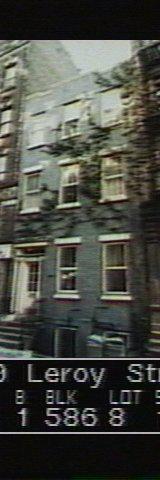
The city photographed every building for its tax records around 1940 and again in the 1980s. NYC Municipal Archives.
Written with AI from the source each entry cites, then fact-checked.
- 1831
Lumber merchant Joseph Hammond builds a Greek Revival house for himself at 30 Leroy Street
Builder John G. Hadden and carpenter Silvanus Gedney completed No. 30 Leroy Street in 1831 for lumber merchant Joseph Hammond, who lived in it himself. It is an excellent early example of Greek Revival, with Ionic columns at the doorway. In 1927 its attic was raised to a full third story and the building became a two-family house, which is probably when the roofline took its present stepped-parapet form.
“…constructed in 1831 by builder John G. Hadden (the original owner of 38 Bedford Street; see 38 Bedford Street) and carpenter Silvanus Gedney for lumber merchant Joseph Hammond…”
- 1873
Henry Gratacap, credited with designing the leather fire helmet, buys the house and rents it to a music publisher
Henry T. Gratacap, a luggage manufacturer, bought 30 Leroy Street in 1873 and leased it out. A volunteer firefighter in the 1830s, he is credited with designing the leather fire helmet in 1836, and his firm made the helmets until he sold the business in 1868. His tenant Allen R. Jollie, also a former volunteer firefighter, published music and made instruments, and his funeral was held in the house after his death on December 17, 1877.
Source: Daytonian in Manhattan
- 1887
Ice cream on the Fourth of July sickens about 80 New Yorkers, including a Leroy Street tenant
The Wheeler family was renting 30 Leroy Street in 1887, when Mr. Wheeler fell ill after eating ice cream on the Fourth of July. He was one of roughly 80 people sickened, and the New-York Tribune ran the headline "Many families poisoned." Investigators first suspected cream left standing too long before freezing, while one doctor, judging by his own symptoms, thought mineral poisoning, probably arsenic, was to blame.
Source: Daytonian in Manhattan
- 1895
Detective Sergeant John Perrazzo, who worked Italian cases, dies of pneumonia at his Leroy Street home
Detective Sergeant John Antonio Perrazzo, who joined the police in 1880 and handled the department's Italian cases, lived at 30 Leroy Street with his wife. He caught a cold on November 17, 1895, and it turned to pneumonia. A police surgeon treated him at home, but he died five days after falling ill, at age 41.
Source: Daytonian in Manhattan
Further reading
- The 1830 Joseph Hammond House - 30 Leroy StreetDaytonian in Manhattan
Nearby
- 32 Leroy Street2 entries
- 26 Leroy Street1 entry
- 34 Leroy Street5 entries
- 36 Leroy Street1 entry
- 22 Leroy Street2 entries
- William Huyler House42 Bedford Street | 5 entries