Union Porcelain Works
300 Eckford Street | Greenpoint | built 1901
Open on the map7 entries

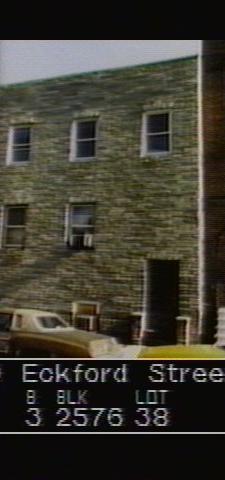
The city photographed every building for its tax records around 1940 and again in the 1980s. NYC Municipal Archives.
Written with AI from the source each entry cites, then fact-checked.
- 1856
William Boch & Brothers, porcelain makers, work from 300 Eckford Street by 1856
Directories trace the porcelain firm William Boch & Brothers to 300 Eckford Street by 1856. William Boch had been listed as a porcelain manufacturer in a Williamsburgh directory for 1850-51, and the firm's advertisements began appearing in 1853. Much of the soft-paste porcelain trade of that era was devoted to doorknobs, sink taps, clock faces and insulator caps for electrical equipment. This is an earlier firm on the lot, before Union Porcelain Works.
Source: bklynlibrary.org
- 1863
Thomas C. Smith gains the Boch firm, which becomes Union Porcelain Works
The Boch firm, a stock company owned by its employees, had made soft-paste porcelain fixtures and decorative wares for about ten years when it was forfeited in 1863 to its majority stockholder, Thomas C. Smith. Smith was an architect who taught himself the ceramics trade. He brought in finer materials, hotter kilns, steam-driven wheels, lathes and casting molds so true hard-paste porcelain could be made in quantity. An 1868 insurance map shows the factory buildings at 300 Eckford.
Source: bklynlibrary.org
- 1876
Union Porcelain Works sends wares and the Century Vase to the Philadelphia Centennial
For the nation's 1876 centennial fair in Philadelphia, the works sent a large set of wares. Karl L. H. Muller, the German-born sculptor who headed its creative department, designed the Century Vase, which became the firm's signature piece. The 22-inch vase carries a profile of George Washington, bison-head handles and a vignette of a workman at a lathe. Examples are now held by the Brooklyn Museum, the Smithsonian and the Metropolitan Museum.
Source: bklynlibrary.org
- 1877
Union Porcelain and Empire China workers play baseball to a draw
Greenpoint's pottery firms also competed on the ball field. In August 1877 the Brooklyn Union reported keen rivalry among the baseball players employed by Union Porcelain and the Empire China Works. A recent game between the two sides had ended in a draw, and another was to be tried within days.
Source: bklynlibrary.org
- 1880
Union Porcelain Works is left out of the 1880 census after refusing to be counted as pottery
Census officers wanted to list the factory under earthenware or under brick and tile, never as porcelain. The works refused a heading it considered misleading, so it was omitted from the count. The editor of the porcelain section in Stiles's 1884 history of Brooklyn called the treatment of local porcelain makers an injustice.
Source: bklynlibrary.org
- 1901
Thomas C. Smith dies, his will is contested, and his son Charles takes over the works
Thomas C. Smith, who had taken over the works in 1863, died in 1901. His daughter Ella Corwine, left out of the will, challenged it by claiming undue influence by her siblings; the case ended in an adjustment and was discontinued. Charles H. L. Smith, his eldest son, had been working with him and took over as proprietor. Smith had been indicted in 1897 on a technical embezzlement charge and acquitted.
Source: bklynlibrary.org
- 1922
The Union Porcelain Works property at 300 Eckford is foreclosed and sold in 1922
The firm kept going until the 300 Eckford Street property was foreclosed and sold in 1922. The Times Union reported the foreclosure that October. A 1916 advertisement had shown the factory's imposing front and large kilns.
Source: bklynlibrary.org
Nearby
- 177 Greenpoint Avenue2 entries
- Sunshine Laundromat & Pinball860 Manhattan Avenue | 2 entries
- St. Anthony of Padua Church rectory862 Manhattan Avenue | 3 entries
- RKO Greenpoint Theatre825 Manhattan Avenue | 5 entries
- Union Baptist Church151 Noble Street | 7 entries
- Greenpoint Savings Bank807 Manhattan Avenue | 5 entries