Al Hirschfeld Theatre
302 West 45th Street | Hell's Kitchen | built 1924
Open on the map10 entries

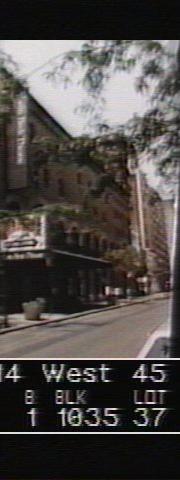
The city photographed every building for its tax records around 1940 and again in the 1980s. NYC Municipal Archives.
Written with AI from the source each entry cites, then fact-checked.
- 1923
Martin Beck, ousted from the Orpheum Circuit, plans a theater of his own
Martin Beck opened the Palace in 1913 but lost control of it to Albee, keeping only 25 percent, and in 1923 he was ousted from his post at the head of the Orpheum Circuit. Refusing to leave New York, he planned a theater of his own, the Martin Beck, and had the Orpheum's house architect, G. Albert Lansburgh, move from San Francisco to design it. Beck ran it as a legitimate house, though he always thought of himself first of all as a vaudeville producer.
- 1923
Six brownstones on West 45th Street are bought and a seventh added for Beck's theater
The lot was first occupied by seven three-story brownstone townhouses. In July 1923 Martin Beck acquired six of the dwellings, at 302 to 312 West 45th Street, and that September he added the seventh, at number 314. Oddie and Falk won the construction contract for a theater budgeted at $1 million, with about 1,160 seats, and the old houses were being razed by November 1923.
“In July 1923, Martin Beck acquired six dwellings at 302 to 312 West 45th Street, with the intent of building a legitimate theater there.”
Source: Wikipedia
- 1924
Lansburgh brings a Moorish arcade to West 45th Street, west of Eighth Avenue
G. Albert Lansburgh, a movie-palace specialist who had earlier designed fantastical houses including the Golden Gate Theater in San Francisco and the Hill Street Theater in Los Angeles, gave Beck a long, triple-story Moorish arcade along 45th Street. It contrasted with the neoclassicism of nearby Broadway theaters. Beck also defied Broadway custom by choosing a site west of Eighth Avenue, even though eight theaters already stood on the block between Broadway and Eighth.
- 1924
The Martin Beck Theatre opens with Madame Pompadour
Architect G. Albert Lansburgh designs the Moorish- and Byzantine-style theater for vaudevillian Martin Beck, and it opens on November 11, 1924. According to Beck's wife Louise, it is the only theater in New York City owned outright without a mortgage. The opening production, Madame Pompadour, runs for 80 performances.
Source: Wikipedia
- 1931
The Group Theatre stages its first production, The House of Connelly, at the Beck
The Group Theatre staged its first production, Paul Green's The House of Connelly, at the Martin Beck in September 1931. Its predecessor, the Theatre Guild Acting Company, had made its own debut at the theater two years earlier in the Russian play Red Rust. Lunt and Fontanne returned later that year in the Guild's Reunion in Vienna.
“The Group Theatre had its first production that September with the opening of Paul Green's The House of Connelly.”
Source: Wikipedia
- 1977
Frank Langella's Dracula gives the Beck a hit in 1977, running 925 performances
After a run of short-lived shows, including two productions in 1972 and 1973 that lasted a single performance each, the Beck scored a hit in 1977 with Dracula, starring Frank Langella. It ran for 925 performances. In 1976 William L. McKnight had transferred the Beck, along with the rest of Jujamcyn's theaters, to his daughter Virginia and son-in-law James H. Binger.
“…the theater had a hit in 1977 with the opening of the play Dracula, featuring Frank Langella, which ran for 925 performances.”
Source: Wikipedia
- 1987
The city landmarks the theater's facade and interior
New York City designates both the facade and the auditorium of the Martin Beck Theatre as landmarks on November 4, 1987, a decision the Board of Estimate ratifies the following March. The recognition protects G. Albert Lansburgh's Moorish- and Byzantine-influenced design more than six decades after the theater opened.
Source: Wikipedia
- 2003
A neon self-portrait of Al Hirschfeld tops the theater's new marquee
The new marquee installed when the Martin Beck Theatre took Al Hirschfeld's name in June 2003 is topped by a neon-outlined self-portrait of the caricaturist. At first red neon made the figure appear to draw ink from its own head, which gave it a macabre look, so blue neon soon replaced it. Hirschfeld had spent eight decades drawing the passing moments of stage performances in his looping sketches.
Source: playbill.com
- 2003
The theater is renamed for caricaturist Al Hirschfeld
In June 2003, the Martin Beck Theatre is renamed the Al Hirschfeld Theatre to mark what would have been the 100th birthday of the Broadway illustrator, who died in January of that year. The change makes Hirschfeld the first visual artist to have a Broadway theater named for him.
Source: Wikipedia
- 2013
Kinky Boots begins a six-year run at the Hirschfeld
The musical Kinky Boots opens at the Al Hirschfeld Theatre in April 2013 and runs for six years, with 2,507 performances. Earlier long runs at the theater include The Teahouse of the August Moon, which ran for 1,027 performances from 1953, and Dracula, with 925 performances starting in 1977.
Source: Wikipedia
Further reading
- Al Hirschfeld TheatreWikipedia
Nearby
- The Whitby325 West 45th Street | 3 entries
- Saint Luke's Lutheran Church308 West 46th Street | 2 entries
- Joe Allen326 West 46th Street | 5 entries
- Row NYC Hotel (Hotel Lincoln, Milford Plaza)700 8th Avenue | 9 entries
- Tony Kiser Theater681 8th Avenue | 6 entries
- John Golden Theatre252 West 45th Street | 14 entries