306 Bowery
NoHo | built 1820
Open on the map7 entries

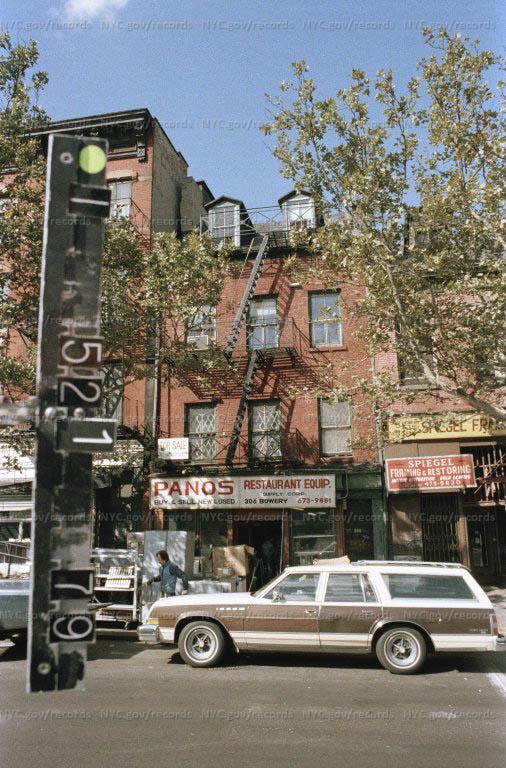
The city photographed every building for its tax records around 1940 and again in the 1980s. NYC Municipal Archives.
Written with AI from the source each entry cites, then fact-checked.
- 1820
George Lorillard builds 306 Bowery as a rental investment in the Federal style
The tobacco heir George Lorillard had this three-and-a-half-story house put up in 1820, when the Bowery was being developed for New York's growing middle class. It has Flemish-bond brick, sandstone lintels and a peaked roof with dormers where a servant could board. Lorillard also built the neighboring houses at 308 and 310 Bowery, and the three were meant as investments rather than family homes.
Source: Ephemeral New York
- 1841
Lorillard sells the Bowery house, which passes to a doctor and then to publisher Mahlon Day
After Lorillard sold 306 Bowery in 1841, a physician named E. F. Maynard, who had already lived there, bought it. The next owner was Mahlon Day, a publisher and bookseller, and his estate held the house until 1899. By the middle of the century commerce, theaters and saloons were pushing out the Bowery's middle-class residents.
Source: Ephemeral New York
- 1876
Architect A. J. Bogart turns the ground floor of 306 Bowery into a storefront
In 1876 the owner, the Day Estate, hired architect A. J. Bogart to bring the ground floor down to street level, with iron columns and girders carrying a new shop front and a two-story addition at the rear. The upper floors stayed a dwelling above the shop.
“The building's first story was raised and a storefront was installed at ground level in 1876 by architect A.J. Bogart and owner the Day Estate.”
- 1899
German Exchange Bank president Michael Adrian buys 306 Bowery; his family keeps it until 1965
Read more
In 1899 Michael Adrian, president of the German Exchange Bank, acquired 306 Bowery. His bank served the German immigrants who had settled around the Bowery, and he had already built the neighboring 304 Bowery in 1876-77. By 1905 the house held two families of Austrian immigrants, sixteen children and two boarders in all, and the Adrian family owned it through 1965.
“The building was acquired in 1899 by Michael Adrian, president of the German Exchange Bank…”
- 1940
The Ace Hy-Sign Company occupies 306 Bowery from about 1940 to 1955
By 1915 commercial tenants had taken over the upper floors, though the building was still classified as a one-family dwelling with a store. Most occupants were small businesses that did not last, but the Ace Hy-Sign Company remained from around 1940 through 1955.
“…the Ace Hy-Sign Co., which remained from around 1940 through 1955…”
- 1966
306 Bowery becomes artists' lofts, and actor Willem Dafoe rents space here around 1980
In 1966 the upper floors became artists' lofts, as demand for manufacturing space and commercial rents declined. The Landmarks Preservation Commission also held a public hearing that year on whether the house should be an individual landmark. The actor Willem Dafoe rented space in the house around 1980.
- 2016
Designer Patricia Field sells 306 Bowery, her boutique's home, to focus on costume work
Patricia Field, the stylist and costume designer known for Sex and the City, moved her boutique to 306 Bowery after earlier shops on Washington Place, 8th Street and West Broadway. She owned the building, and she sold it in 2016 to concentrate on designing costumes for television and film.
“…finally to 306 Bowery in NoHo, where Field owned the property. She sold it in 2016 to concentrate on costume designing…”
Source: Wikipedia
Further reading
- This sweet 1820s house is a reminder that the Bowery was once a middle-class residential streetEphemeral New York
Nearby
- 304 Bowery2 entries
- Bowery Poetry Club308 Bowery | 4 entries
- 302 Bowery2 entries
- Clover Hotel312 Bowery | 3 entries
- 300 Bowery3 entries
- 298 Elizabeth Street3 entries