Kimball Building
307 West Broadway | SoHo | built 1892
Open on the map6 entries

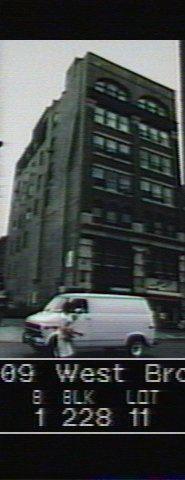
The city photographed every building for its tax records around 1940 and again in the 1980s. NYC Municipal Archives.
Written with AI from the source each entry cites, then fact-checked.
- 1890
An earlier building at 241 South Fifth Avenue holds a marshmallow-drop candy factory until its sale
Before the present building, smaller structures stood here on South Fifth Avenue, which was renamed West Broadway in 1896. In the 1870s No. 241 housed Franchi & Lertora, makers of marshmallow drops. On February 19, 1890, this building and its neighbor at No. 239 went to auction, and both lasted only about two more years.
Source: Daytonian in Manhattan
- 1892
Architect Douglas Smyth plans a seven-story factory for Alonzo Kimball
Architect Douglas Smyth submitted plans on June 10, 1892, for a seven-story factory of brick and stone for Alonzo Kimball, with the cost estimated at $45,000. The design has a two-story limestone base with massive banded piers, the central one crowned by a colossal Ionic capital. Above it rises a four-story brick midsection whose third-floor arched windows have fanlights with metal spokes.
Source: Daytonian in Manhattan
- 1893
Heating contractors Johnson & Morris become the first tenants of the new building
Kimball was still perfecting his business when the building went up, so the first tenant was Johnson & Morris, a firm that designed and installed heating, hot-water and ventilation systems for large structures. They moved in during April 1893 and stayed through 1897. In 1896 South Fifth Avenue was renamed West Broadway, giving the building its 307-309 address.
Source: Daytonian in Manhattan
- 1898
A. Kimball Co., maker of punched pin-tickets for clothing, moves into the building
A. Kimball Co. was incorporated in 1898 by Alonzo Kimball, Arthur G. Thompson and Kimball's son-in-law Melville Asbury Marsh, and it moved into the building that bore its name. Kimball, born in New Hampshire in 1828, had worked for the Singer Sewing Machine Company before inventing pin-tickets, small cardboard clothing tags with punched holes that stores processed at day's end to tally sales. Daytonian in Manhattan calls them a forerunner of punch cards and bar codes. After Kimball died in December 1916, Marsh became president.
Source: Daytonian in Manhattan
- 1957
A. Kimball Co. leaves after nearly six decades and small firms, including a surplus aircraft-parts dealer, move in
The company occupied the West Broadway address until August 1957, when the building was sold to an investor. It then became home to assorted small businesses, among them A. M. Aircraft Parts Co., which resold surplus military equipment and was listed here by 1959.
Source: Daytonian in Manhattan
- 1977
A 1977 conversion turns the upper floors into one artists' live-work apartment per floor
Upper floors were converted in 1977, with a single apartment on each level above the ground floor. City building officials limited the apartments to joint living and working quarters for artists.
Source: Daytonian in Manhattan
Nearby
- John R. Murray House375 Canal Street | 4 entries
- 373 Canal Street1 entry
- 371 Canal Street1 entry
- 311 West Broadway1 entry
- Webb Building (365-367 Canal Street)365 Canal Street | 4 entries
- 363 Canal Street1 entry