Housman House
308 St John Avenue | Westerleigh | built 1899
Open on the map6 entries

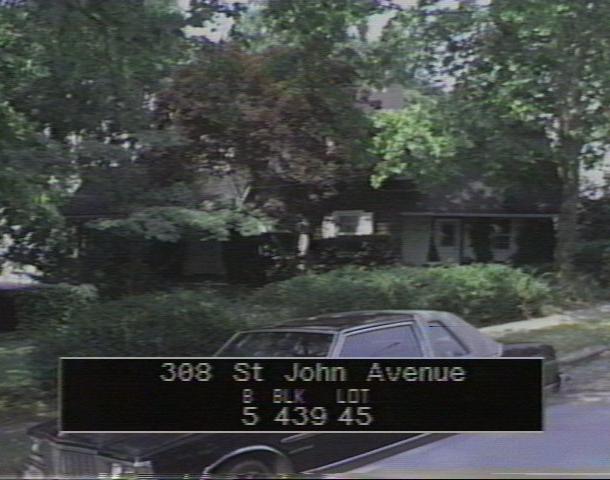
The city photographed every building for its tax records around 1940 and again in the 1980s. NYC Municipal Archives.
Written with AI from the source each entry cites, then fact-checked.
- 1730
A one-room stone farmhouse goes up on the Dongan family's Castleton manor
The oldest part of the house, a small one-room stone dwelling, was built around 1730 on Castleton, the Dongan manor. It stands on the old Watchogue Road, whose name the Landmarks Preservation Commission traces to "Watch Oak." In the 18th century the road linked the ferry at the Watering Place, now Tompkinsville, with New Blazing Star, now Rossville, as part of the New York to Philadelphia stagecoach route.
- 1760
Millwright Peter Housman buys 46 acres and adds a clapboard wing to the stone house
In 1760 Peter Housman, a prosperous millwright, bought forty-six acres of the Castleton manor from Thomas Dongan, heir of Walter Dongan, a nephew of New York governor Thomas Dongan. Housman then added a larger clapboard section to the stone house. That wing is also a story and a half but stands taller than the older part, with two dormers in a less steeply pitched roof.
- 1784
Peter Housman is killed resisting a robbery by a band of Jersey raiders
In 1784 Peter Housman was murdered when he resisted a robbery attempt by raiders from New Jersey. His will left his eldest son, John, five pounds and his pick of the silver watches on top of his share, with the estate divided among Housman's eleven children.
“…the murder of Peter Housman In 1784, when he resisted an attempted robbery by a party of Jersey raiders.”
- 1826
Judge John Housman's debts force the family farm onto the auction block
John Housman bought the farm from his father's executors and lived here while serving Richmond County in several posts, among them county supervisor, assemblyman, surrogate and Common Pleas judge. After he died in 1825 his goods could not cover the claims against him, so in spring 1826 his administrators advertised the 59-acre farm, suggesting it would suit a tanyard. John Baker bought it at auction.
- 1887
The old farm becomes Prohibition Park, a summer colony for temperance supporters
After passing through Vanderbilt and Vreeland hands, a buyer in 1887 took the house and twenty-five acres to cut into small lots for Prohibition Park, a summer resort for members of the temperance movement. Its streets honored the movement's leaders, including former Kansas governor St. John, whose name is on the house's address. Three lots were kept for the house, and the area grew into Westerleigh.
“…sold, in 1887, to be laid out in small lots as a summer resort, known as "Prohibition Park", for members of the temperance movement.”
- 1970
The Landmarks Preservation Commission designates the Housman House
Following a May 26, 1970 hearing, with the owner and Staten Island Community Board 1 both in favor, the commission named the house one of the city's few surviving 18th-century Dutch farmhouses. It noted the older section's deep roof overhang and heavy plank front door, and the Greek Revival doorway with Greek key pilasters sheltered by a rustic log porch.
“…the Housman House Is one of the few remaining 18th century Dutch farmhouses in New York City…”
Further reading
- Peter Houseman HouseWikipedia
Nearby
- Church of the Holy Family366 Watchogue Road | 1 entry
- 1440 Forest Avenue Shopping Plaza1440 Forest Avenue | 4 entries
- Church of St. Roch602 Port Richmond Avenue | 3 entries
- Church of the Blessed Sacrament30 Manor Road | 1 entry
- St. Teresa of the Infant Jesus Church1632 Victory Boulevard | 2 entries
- St. Adalbert's Church25 St Adalbert Place | 3 entries