Garrett J. Westervelt House
308 West 11th Street | West Village | built 1843
Open on the map5 entries

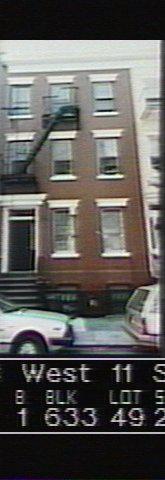
The city photographed every building for its tax records around 1940 and again in the 1980s. NYC Municipal Archives.
Written with AI from the source each entry cites, then fact-checked.
- 1842
Nicholas Brinckerhoff builds a row of three Greek Revival houses at 308 to 312 West 11th Street
The Greenwich Village Historic District report says Nos. 308, 310 and 312 were put up in 1842-43 for Nicholas Brinckerhoff on land he bought in 1842, with a continuous cornice line uniting them. Brinckerhoff made No. 310 his own home. The arch-patterned cast-iron stoop railing at No. 308 is a later Italianate addition, and sheet-metal cornices were later fitted over its doorway and windows.
“…these three houses of 1842-43 are fine examples of Greek Revival row houses. They were erected for Nicholas Brinckerhoff on land he had purchased in 1842.”
- 1857
Boarder Henry Vanostrand opens a daguerreotype studio on Bleecker Street
From almost the start the house, then 102 Hammond Street and renumbered 308 West 11th Street in 1864, took in boarders. Widows ran it: Martha Rose by 1847, and Maria Haring from around 1853. One of Haring's boarders, the clerk Henry Vanostrand, stayed for several years and in 1857 opened a daguerreotype studio on Bleecker Street, offering an early form of photography that made portraits affordable.
Source: Daytonian in Manhattan
- 1868
Washington Market merchant Garrett J. Westervelt turns the boarding house into his home
Around 1868 the house became a private residence for Garrett J. Westervelt, a merchant at Washington Market, and his wife, Annie. They almost certainly added the Italianate ironwork and the sheet-metal cornices over the entrance and windows that still mark the facade. The Westervelts stayed more than three decades; their son Frank died at age seven on July 16, 1872, and his funeral was held in the parlor two evenings later.
Source: Daytonian in Manhattan
- 1919
A roomer at 308 West 11th Street, John P. Fitzgerald, is listed as dead of wounds
James F. Carroll bought the house from James D. Westervelt on March 29, 1906, and soon became a Commissioner of Deeds. The Carrolls rented a room to John P. Fitzgerald, who joined the military when the United States entered World War I. He was wounded in battle and taken to a field hospital, and on November 9, 1919, the War Department listed him among those who died of wounds.
Source: Daytonian in Manhattan
- 1987
The house, never divided into apartments, sells for $800,000 and is renovated inside
James Carroll died on February 20, 1920, and his funeral took place in the house before a requiem mass at St. Veronica's, the church on Christopher Street; his widow, Mary, sold the property in May 1922. Remarkably, the building was never converted to apartments. After a 1987 sale for $800,000 its interiors were renovated, leaving essentially none of the 1842 elements inside, while the exterior still shows the updates of about 1868.
Source: Daytonian in Manhattan
Further reading
- The 1842 Garrett J. Westervelt House - 308 West 11th StreetDaytonian in Manhattan
- Then & Now photos: 308 West 11th StreetVillage Preservation: Greenwich Village Then & Now
Nearby
- Rev. Robert Travis House312 West 11th Street | 5 entries
- The Spotted Pig749 Greenwich Street | 17 entries
- White Horse Tavern302 West 11th Street | 6 entries
- 747 Greenwich Street1 entry
- 745 Greenwich Street1 entry
- 743 Greenwich Street1 entry