Caffe Cino
31 Cornelia Street | West Village | built 1900
Open on the map12 entries

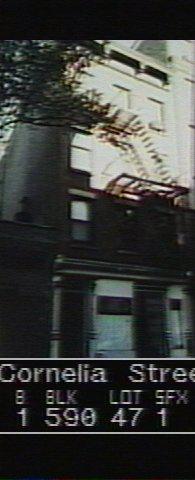
The city photographed every building for its tax records around 1940 and again in the 1980s. NYC Municipal Archives.
Written with AI from the source each entry cites, then fact-checked.
- 1877
Builder Benjamin Warner replaces an old Cornelia Street house
Builder Benjamin Warner, who probably acted as his own architect, completed a four-story red-brick building at 31 Cornelia Street in 1877 for Michael Maloney. It replaced an earlier house on the site and stood on a cast-iron storefront base. The ground floor held a grocery run by Ellen Maloney, with working-class tenants renting rooms above.
Source: Daytonian in Manhattan
- 1929
Prohibition agents name the saloon at 31 Cornelia Street among thirteen places charged with selling liquor
The ground floor held a saloon owned by Maria Coutourier when Prohibition agents caught up with her in 1929. A March 20 list in the New York Evening Post named thirteen night clubs, speakeasies and restaurants accused of selling liquor. Coutourier's place was on the list, alongside Evelyn Nesbit's Swannee Club, and it faced the threat of being padlocked for a year.
Source: Daytonian in Manhattan
- 1958
Joe Cino opens Caffe Cino in the ground-floor storefront
Joe Cino arrived in New York from Buffalo in 1948 at age sixteen and opened the Caffe Cino at 31 Cornelia Street in December 1958. Like other Village coffeehouses it hosted poetry readings, and these gradually turned into plays. It became known as the first Off-Off-Broadway theater in Manhattan.
Source: Daytonian in Manhattan
- 1960
The Cino starts Sunday-night readings with Capote and Wilde
A series called the Caffe Cino Repertory began in February 1960, giving the cafe Sunday night theatrical readings. The first, on February 7, paired Truman Capote's A Christmas Memory with a scene from Oscar Wilde's The Importance of Being Earnest. Historian Amanda Davis saw in the choice of two prominent gay writers an early LGBT influence at the cafe.
“The first of these, performed on February 7, 1960, included a reading of A Christmas Memory by Truman Capote and a scene from The Importance of Being Ernest…”
- 1960
A Village Voice column gives café theater the name Off-Off-Broadway
Michael Smith's Village Voice column on café plays was retitled "Off-Off-Broadway," and the first column under that name appeared in the November 24, 1960 issue. Joe Cino was reluctant about the label, insisting "We're in café." The name stuck, and author Stephen J. Bottoms later called the Cino the first off-off-Broadway venue of importance.
“The first column with this title appeared in the November 24, 1960 issue.”
- 1962
Alice in Wonderland becomes the first show on the Cino's two-performances-a-night schedule
A 32-minute adaptation of Alice in Wonderland in 1962 was the first play run twice nightly. Joe Cino called it among the most beautiful things at the cafe, thanks to Johnny Dodd's lighting, which lit only the actors and left the audience in darkness. Cino introduced each play himself, ending with "It's magic time," and reportedly chose plays by playwrights' astrological signs rather than reading scripts.
- 1964
Lanford Wilson's The Madness of Lady Bright premieres at Caffe Cino
Lanford Wilson's play The Madness of Lady Bright opened at Caffe Cino in June 1964. The tiny cafe was staging early works by playwrights who were then unknown, including Wilson, Sam Shepard and Tom Eyen. New York Post critic Jerry Tallmer wrote that Wilson showed a certain sure talent.
Source: Daytonian in Manhattan
- 1965
The Cino reopens after a fire, with a benefit raised in Edward Albee's theater space
A fire in 1965 wrecked the cafe's interior and left boards over much of the facade. Playwright H. M. Koutoukas organized a benefit in the Writers Stage Theatre, a space donated by Edward Albee, a loyal patron. The Caffe Cino reopened on May 18, 1965 with Koutoukas's play With Creatures Make My Way.
“…the Caffe Cino reopened on May 18, 1965 with H.M. Koutoukas' With Creatures Make My Way.”
- 1965
Cino plasters the facade with abstract posters so passing police can't read them
As police harassment of the cafe grew, Joe Cino began attaching posters to the front of the building, perhaps inspired by the boards that covered it after the fire. Most were made by Kenny Burgess, in abstract designs with upside-down and sideways lettering. Regulars could read them, but unsuspecting cops would take them for artwork.
“Joe Cino started attaching posters to the facade to shield the venue from the prying eyes of passing police.”
- 1966
Dames at Sea packs the tiny Caffe Cino for eight weeks
In 1966 Caffe Cino staged Dames at Sea, a 30-minute spoof of 1930s Hollywood musicals that is arguably its best-remembered production. It played to packed houses for two months in a room so full that two people once sat on the cigarette machine. Eighteen-year-old Bernadette Peters sang in the show, and after a producer moved it to a larger theater, Carol Burnett saw it and invited Peters onto her show.
Source: Daytonian in Manhattan
- 1967
Joe Cino dies at 35 and the Caffe Cino closes the following year
Joe Cino grew deeply depressed after the death of his partner, Jon Torrey, in January 1967. He seriously injured himself on March 30 and died three days later at age 35. His friends tried to keep the Caffe Cino open, but it closed in 1968.
Source: Daytonian in Manhattan
- 2019
The city designates the Caffe Cino building an individual landmark
The Landmarks Preservation Commission designated 31 Cornelia Street as the Caffe Cino on June 18, 2019, after a June 4 hearing at which forty people testified in favor and no one spoke against. Supporters included the NYC LGBT Historic Sites Project and city officials. Federal recognition had come earlier, when the building was listed on the National Register on November 9, 2017.
Further reading
- Caffe CinoWikipedia
- The Former Caffe Cino - 31 Cornelia StreetDaytonian in Manhattan
Nearby
- Agee studio building33 Cornelia Street | 3 entries
- Cornelia Street Cafe building29 Cornelia Street | 4 entries
- 35 Cornelia Street2 entries
- 25 Cornelia Street1 entry
- Zito's Bakery building259 Bleecker Street | 4 entries
- 257 Bleecker Street3 entries