Bridge Street Church (Wunsch Building)
311 Bridge Street | also 307 Bridge Street | Downtown Brooklyn | built 1847
Open on the map7 entries

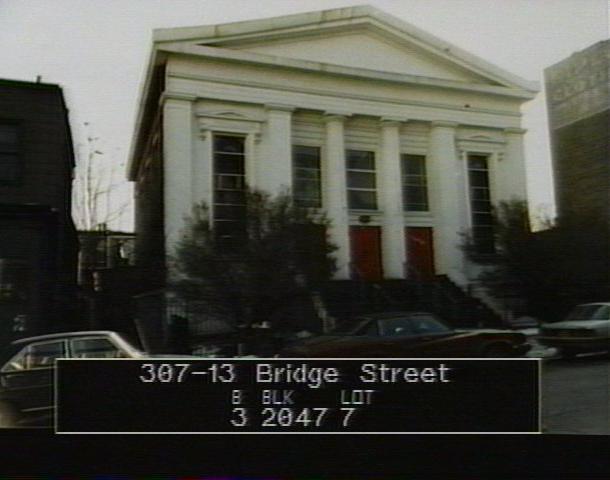
The city photographed every building for its tax records around 1940 and again in the 1980s. NYC Municipal Archives.
Written with AI from the source each entry cites, then fact-checked.
- 1846
The First Free Congregational Church buys three lots on Bridge Street and builds a $14,000 temple-front church
The congregation, which charged no seat rentals, began as a Free Presbyterian church in 1841 and became Congregational in 1845. In 1846 it bought three lots on Bridge Street, and under its first minister, the Rev. Isaac N. Sprague, built the church in 1846-47 at a cost of $14,000. Plans for a tower modeled on a Greek monument were never carried out.
“The 'Free' in the name refers to the Church's policy of not charging a rental fee for its seats. ... constructed, at a cost of $14,000.”
- 1847
An unknown builder gives the Bridge Street church a Greek Revival front with Italianate touches
The church was a simple brick and wood rectangle with a temple front: two fluted wooden columns and a low pediment, with a recessed porch behind them. Console brackets and shallow pediments over the large side windows borrowed from the then-new Italianate style. An early-twentieth-century remodel later filled in the porch with three pairs of doors and stained glass.
- 1854
The African Wesleyan Methodist Episcopal Church buys the building and shelters escaping slaves in its basement
After the first congregation's internal disputes forced it to sell, Brooklyn's oldest Black congregation bought the church in 1854 for $12,500, when it had 292 members. Its members had withdrawn from the Sands Street Methodist church and incorporated their own in 1818. The landmark report says the congregation was active in the anti-slavery movement and that many escaping slaves were housed in the basement.
- 1885
A fire damages the church's interior in 1885, and repairs follow within months
A fire burned part of the Bridge Street church in 1885. The landmark report says the damage appears to have been confined to the inside. The building was repaired and its furnishings replaced within a few months.
“A fire burned part of the building in 1885 but the damage seems to have been limited to the inside. It was repaired and furnishings replaced within months.”
- 1948
The congregation follows its members to Bedford-Stuyvesant and leaves Bridge Street
The African Wesleyan Methodist Episcopal congregation left in 1948 as most of its members had moved to Bedford-Stuyvesant. The Gospel Temple Church of God in Christ held the building for almost two years, and then a businessman owned it for five more. The area around it had become commercial instead of residential, and the building was converted for industrial use.
“The A.W.M.E. Congregation remained in the building until 1948. Then the church followed most of its members who had moved to the Bedford-Stuyvesant section of Brooklyn.”
- 1968
The Polytechnic Institute takes over a building that had housed a trade school
From 1955 to 1968 the former church held classrooms and offices for the Institute of Design and Construction, a school for the building trades. In 1968 the Polytechnic Institute of New York took it over. Most of the work was done on the interior, so the exterior looks much as it did in the mid-nineteenth century.
- 1981
The Landmarks Preservation Commission designates the former church, calling it a rare Greek Revival survivor
The commission designated the building a landmark on November 24, 1981, after hearings in 1979 at which three witnesses spoke in favor and one against. It cited the building as one of the very few non-residential Greek Revival structures left in Brooklyn. It also credited the congregation that used it, Brooklyn's oldest Black congregation, for its part in the anti-slavery movement.
“…one of the very few non-residential buildings of this style surviving in Brooklyn ... for 84 years the building served the African Wesleyan Episcopal Church…”
Further reading
- Wunsch BuildingWikipedia
Nearby
- BellTel Lofts101 Willoughby Street | 8 entries
- The Brooklyner111 Lawrence Street | 3 entries
- New York and New Jersey Telephone and Telegraph Building81 Willoughby Street | 7 entries
- Old Brooklyn Fire Headquarters365 Jay Street | 9 entries
- AVA DoBro100 Willoughby Street | 1 entry
- Transportation Building370 Jay Street | 8 entries