IFC Center (the former Waverly Theater)
323 Avenue of the Americas | West Village | built 1853
Open on the map7 entries

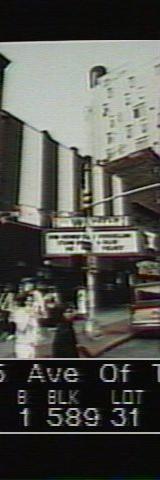
The city photographed every building for its tax records around 1940 and again in the 1980s. NYC Municipal Archives.
Written with AI from the source each entry cites, then fact-checked.
- 1853
The West Reformed Dutch Church occupies a new church at 323-325 Sixth Avenue
The Landmarks Preservation Commission dates the church building to about 1853, built for the West Reformed Dutch Church on a lot that several congregations had already used since the 1830s. Tax records show that congregation in the building until 1875-76, when the Union Reformed Dutch Church took over and stayed until at least 1896. The building is the one that later became the Waverly Theater and the IFC Center.
“…originally constructed for the West Reformed Dutch Church c. 1853 although the site had already been used by several congregations beginning in the 1830s.”
- 1893
J & R Lamb leases the church and turns it into a stained-glass factory
In 1893 the J & R Lamb studio, which Joseph and Richard Lamb had started in the city in 1857, leased the old church and converted it to a factory for church stained glass. The building was only partly commercial even then: a 1899 alteration filing by the Union Reformed Church shows part of it still served the congregation.
- 1937
Harrison G. Wiseman converts the former church into the Waverly movie theater
In 1937 the Luxor-Bleecker Amusement Corporation leased the former church along with the neighboring building at 327 Sixth Avenue. Architect Harrison G. Wiseman gave the church a new front wall and a marquee on Sixth Avenue and extended it 19 feet 2 inches at the rear. The cinema it became was known for decades as the Waverly Theater.
“Architect Harrison G. Wiseman converted no. 323 -325, until then used as a church, into a motion picture theater, adding a new f ront wall and marquee…”
- 1968
The musical Hair mentions the Waverly Theatre, including in the song "Frank Mills"
The 1968 Broadway musical Hair refers to the Waverly Theatre several times. The best-known reference is the song "Frank Mills," which the character Crissy sings at the end of the first act. The building later became the IFC Center.
Source: Wikipedia
- 1976
The Waverly starts midnight screenings of The Rocky Horror Picture Show, and the audience begins talking back
After a weak first release in 1975, The Rocky Horror Picture Show was relaunched as a midnight movie at the Waverly on April 1, 1976. About five months into the run, Louis Farese Jr., a schoolteacher, yelled a line at the screen when the character Janet put a newspaper over her head to shield herself from rain. He, Theresa Krakauskas and Amy Lazarus, who attended together, are credited with starting the convention of talking back to the screen. By that Halloween people were coming in costume as well.
“…beginning its run at the Waverly Theater in New York City on April 1, 1976. ... By that Halloween, people were attending in costume and talking back to the screen.”
Source: Wikipedia
- 1976
Waverly manager Denise Borden promotes Rocky Horror, and balcony regulars invent the rituals
Manager Denise Borden decorated the box-office window with film stills, set up a recorded phone message urging callers to catch the film, and played its soundtrack before each show to get the crowd in the mood. Audiences tossed rice at the wedding scene and threw toilet paper whenever Dr. Scott's face appeared. A band of regulars took the same balcony seats each week, among them Bill O'Brien, remembered as the earliest fan to come in costume as Dr. Frank-N-Furter, and Lori Davis, who wrote Ten Commandments for the show.
Source: Village Preservation
- 2005
The IFC Center opens in the old Waverly with a picket line and a giant inflatable rat
After the Waverly closed in 2001, the building reopened on June 17, 2005 as the IFC Center, opening with Me and You and Everyone We Know. For its first weeks, patrons walked past pickets and a huge inflatable rat, because the new theater had hired only non-union projectionists and the projectionists' union, IATSE Local 306, protested. The complex began with three screens and grew to five in 2009.
Source: Wikipedia
Further reading
- IFC CenterWikipedia
Nearby
- 321 Avenue of the Americas2 entries
- 327 Avenue of the Americas3 entries
- 319 Avenue of the Americas2 entries
- 329 Avenue of the Americas2 entries
- 317 Avenue of the Americas1 entry
- 315 Avenue of the Americas2 entries