McGraw-Hill Building
330 West 42nd Street | Hell's Kitchen | built 1931
Open on the map12 entries

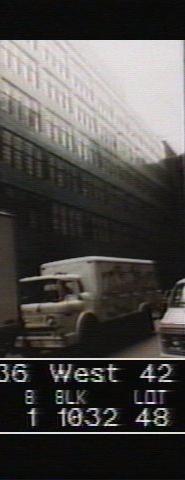
The city photographed every building for its tax records around 1940 and again in the 1980s. NYC Municipal Archives.
Written with AI from the source each entry cites, then fact-checked.
- 1926
Developer John Larkin files plans for a 110-story tower on the future McGraw-Hill site
John A. Larkin spent about three years assembling roughly 47,500 square feet in the middle of the block between 41st and 42nd streets. In 1926 he caught the real-estate world off guard when he filed plans for a 110-story skyscraper there. The scheme came to nothing, and in 1930 Larkin effectively gave the land to McGraw-Hill in a swap, clearing the way for the much shorter blue-green tower that went up instead.
- 1930
McGraw-Hill swaps its Tenth Avenue headquarters for Larkin's 42nd Street lots
The Times announced on May 30, 1930 that McGraw-Hill and Larkin had agreed to trade: the publisher would hand over its Hill Building site at Tenth Avenue and 36th Street and take the 42nd Street land, with the exchange closing on July 1. The company's building committee liked the spot for practical reasons. Land was cheaper west of midtown, the lower floors could hold a printing plant that zoning barred between Third and Seventh avenues, and Grand Central and Penn Station were both within easy reach.
“McGraw-Hill planned to house its printing plant on the lower floors of the new building, something the city's zoning laws did not permit between Third and Seventh Avenues.”
- 1931
Raymond Hood finishes the blue-green McGraw-Hill Building on 42nd Street
Designed by Raymond Hood with J. André Fouilhoux and Frederick Godley, the publisher's headquarters was built in 1930–31 and clad in blue-green terracotta panels alternating with green-framed windows. New Yorkers nicknamed it the Green Building. In 1932 it was the only New York skyscraper shown in the Museum of Modern Art's International Style exhibition.
Source: Wikipedia
- 1931
The blue-green terra cotta is said to be James McGraw's pick, though Hood calls it blue and the company green
Yellow, orange, gray, red and even Chinese red were all considered for the tower's terra-cotta skin before the blue-green was chosen, reportedly by James H. McGraw himself. The architect, Raymond Hood, kept calling the color blue, while the company always said green and nicknamed its headquarters the Green Building and the Green Kremlin. Federal Seaboard Terra Cotta made the glazed blocks in South Amboy, New Jersey, and McGraw-Hill boasted that no building anywhere had used more machine-made terra cotta.
- 1931
The New Yorker pans the new McGraw-Hill Building as a dispiriting German import
When the tower opened in 1931, The New Yorker disliked its long horizontal lines, which it said avant-garde designers had borrowed from Germany, and described the terra cotta as a grayish-green tile that failed to lift the spirits. The writer did concede one virtue: the design had no ornament at all, in keeping with Hood's belief that a business building needed decoration no more than a dynamo or a turbine did.
- 1932
The McGraw-Hill Building is the only New York skyscraper in the Museum of Modern Art's International Style show
In 1932 Henry-Russell Hitchcock and Philip Johnson picked four American buildings for their landmark exhibition on the International Style, and the McGraw-Hill Building was the sole New York entry. Hitchcock called it a turning point, the first tall commercial building deliberately designed as horizontal by an architect since Sullivan's Schlesinger-Mayer building in Chicago of 1903. He and Johnson were less keen on the huge rooftop letters, which they considered a break in the building's otherwise regular system.
“…the McGraw-Hill won the honor of being one of four American buildings, and the only one in New York, to be included in Henry-Russell Hitchcock's and Philip Johnson's exhibition…”
- 1939
Martin Goodman's Timely Comics, the future Marvel, rents space in the tower
Pulp publisher Martin Goodman takes offices in the McGraw-Hill Building for Timely Comics, the company that will later become Marvel Comics. Financial troubles have left McGraw-Hill using only about a third of the building's 575,000 square feet that year, with outside tenants like Goodman filling the rest.
Source: Wikipedia
- 1940
A bus terminal is proposed for McGraw-Hill's empty western lot
McGraw-Hill built on only part of its land, leaving the western portion of the lot undeveloped. In 1940 that parcel was put forward as the site of an interstate bus terminal, because the Lincoln Tunnel entrance to New Jersey was so close. The terminal was approved in early 1941, but the war delayed it, and it was finally built one block south in 1950. A post office was built on the adjacent lot instead.
“The western part of McGraw-Hill's lot ... was proposed as the site of an interstate bus terminal in 1940 ... the terminal was ultimately built one block south in 1950.”
Source: Wikipedia
- 1972
McGraw-Hill moves out and leaves the tower empty for three years
The publisher relocates to a new headquarters at 1221 Avenue of the Americas, ending four decades in Raymond Hood's blue-green tower. The building sits vacant for three years as the surrounding Times Square area deteriorates, costing an estimated $650,000 a year in upkeep and taxes before Group Health Insurance buys it in 1974.
Source: Wikipedia
- 1979
The city designates the vacated McGraw-Hill Building a landmark
McGraw-Hill left its 42nd Street headquarters for 1221 Avenue of the Americas in 1972, after about four decades. On September 11, 1979, the Landmarks Preservation Commission designated the building a city landmark. It was added to the National Register of Historic Places in 1980 and named a National Historic Landmark in 1989.
Source: Wikipedia
- 1981
Owen Morrel's Boomerang sculpture is mounted 300 feet up the tower's corner
As part of a rehabilitation under the building's new owners, a site-specific work by Owen Morrel, an angular metal sculpture titled Boomerang, was fixed to the southeast corner of the tower about 300 feet above the street in 1981. It stayed there for roughly 17 years. After a restoration campaign began in 1998, owner Deco Towers took it down, saying inspections over the previous five years had revealed severe deterioration, and offered to give it to the artist or restore it if funding came through.
Source: Wikipedia
- 2021
Preservationists lose a court fight to save the McGraw-Hill Building's lobby
A 2021 renovation plan approved by the Landmarks Preservation Commission called for gutting the original streamlined lobby. After word of the replacement design spread online, preservationists petitioned to landmark the interior, but the asset manager said the commission had turned down three earlier requests, the lobby having been heavily altered in the 1980s. In September 2021 a state court dismissed a lawsuit seeking to protect it, leaving the owners free to dispose of the stored decorations.
“In September 2021, the New York Supreme Court dismissed a lawsuit from preservationists who sought to protect the lobby, in part because the lobby had been substantially modified.”
Source: Wikipedia
Further reading
- 330 West 42nd StreetWikipedia
Nearby
- Port Authority Bus Terminal625 8th Avenue | 4 entries
- The Orion350 West 42nd Street | 3 entries
- Holy Cross Church331 West 42nd Street | 4 entries
- Holy Cross Church329 West 42nd Street | 4 entries
- Eleven Times Square640 8th Avenue | 13 entries
- Tony Kiser Theater681 8th Avenue | 6 entries