August and Augusta Schoverling House
344 Westervelt Avenue | St. George | built 1900
Open on the map4 entries

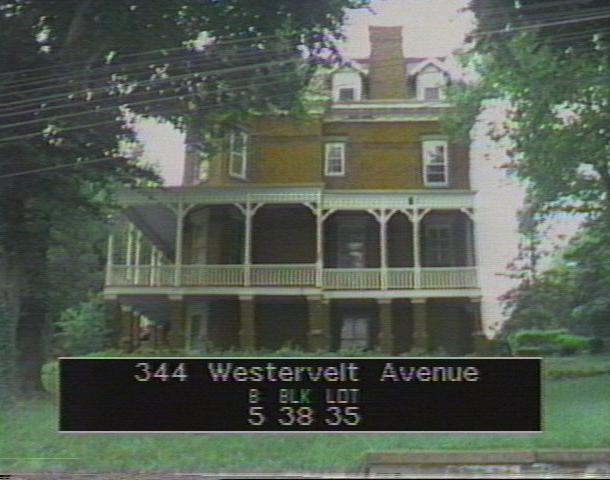
The city photographed every building for its tax records around 1940 and again in the 1980s. NYC Municipal Archives.
Written with AI from the source each entry cites, then fact-checked.
- 1882
Gun importer August Schoverling and his wife Augusta move into their new brick house on Fort Hill
August Schoverling came to New York from Germany in 1859, ran the gun department at Hermann Boker & Co., and in 1865 opened his own arms business with Charles Daly. Augusta bought this lot in September 1880, and by May 1882 the couple appeared at the house in Richmond County's first directory. Schoverling had been born in Osnabruck, Germany, in 1840.
“A house was constructed on the site by May 1882 when the Schoverlings were listed in the first directory for Richmond County.”
- 1908
Judge Morgan L. Ryan buys the house and goes on to organize the city's first juvenile courts
Augusta Schoverling sold the house in 1908 to Morgan L. Ryan, a judge of the Court of Special Sessions. While living here he set up juvenile divisions of the court for Richmond and Queens in 1910 and for the Bronx in 1915, and he became one of the five justices of the new Children's Court. He retired from the bench in January 1924 and sold the house that March.
“In 1910, he was given the responsibility of organizing special divisions of the court to deal with juvenile cases for the boroughs of Richmond and Queens.”
- 1924
Garment workers Salvatore and Fannie Cassaviel buy the house and turn it into apartments
Salvatore and Fannie Cassaviel bought the house in March 1924 and split it into four apartments. In the 1930s they added fire escapes, a basement entrance on Westervelt Avenue and a brick addition to meet the multiple-dwelling code. In 1946 the basement apartment became a dental office for their son Vincent, who lived with his parents on the parlor floor. Fannie stayed until her death in the 1990s.
“In 1946, the apartment in the basement of the house was converted to a dental office for the Cassaviel's son, Vincent…”
- 2001
The Schoverling house becomes a landmark over its owner's written objection
The Landmarks Preservation Commission designated the house on January 30, 2001. Five speakers had backed it at the hearing, while the owner sent a letter opposing it. The commission praised the tawny-red brick, slate mansard and long elevated porch as a late Second Empire design with refined neo-Grec details. The commission had first heard the case for designating the house in 1991.
“January 30, 2001 ... The owner sent a letter in opposition to the designation.”
Nearby
- Vanderzee-Harper House327 Westervelt Avenue | 5 entries
- 411 Westervelt Avenue, Horton's Row411 Westervelt Avenue | 4 entries
- 413 Westervelt Avenue, Horton's Row413 Westervelt Avenue | 3 entries
- 415 Westervelt Avenue, Horton's Row415 Westervelt Avenue | 3 entries
- 417 Westervelt Avenue House, Horton's Row417 Westervelt Avenue | 4 entries
- Brighton Heights Reformed Church320 St Marks Place | 2 entries