P.S. 64 (CHARAS/El Bohio)
350 East 10th Street | also 605 East 9th Street | East Village | built 1906
Open on the map8 entries

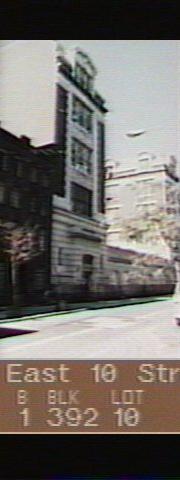
The city photographed every building for its tax records around 1940 and again in the 1980s. NYC Municipal Archives.
Written with AI from the source each entry cites, then fact-checked.
- 1906
C.B.J. Snyder's P.S. 64 pairs a French Renaissance design with a street-accessible auditorium
Designed by the Board of Education's architect C.B.J. Snyder, the school runs through the block from East 9th to East 10th Street, with a paved court on each front in his H-plan. Its red brick, limestone base, white terra-cotta trim and convex slate mansard follow the French Renaissance style. The Landmarks Commission calls its below-grade assembly room, reachable from the street, the earliest surviving example in an elementary school.
“…the earliest extant example of a below grade assembly room accessible from the street in an elementary school…”
- 1911
Streetcars drown out The Merchant of Venice in the schoolyard, and Sydney Greenstreet performs scenes instead
In 1911 the Board of Education began staging free outdoor plays in school playgrounds, and P.S. 64 hosted the first because it was the first school with electric lights in its courtyard. More than 1,500 people crowded in, with others on fire escapes and rooftops, but streetcar noise and the crowd made the actors inaudible. Sydney Greenstreet and others gave short scenes instead, and the full play was staged three days later in the auditorium.
“More than 1,500 people crowded the courtyard and many more perched on neighboring fire escapes and rooftops to see the free performance of Shakespeare's Merchant of Venice.”
- 1912
Pupils form the Local No. 2 Arithmetic Union and walk out to keep their principal
In 1912 many P.S. 64 students followed the example of pupils at rival P.S. 19 and walked out of class, calling themselves the Local No. 2 Arithmetic Union. They had heard that their highly popular principal was about to be transferred away.
“…students from P.S. 64, in response to a similar action by students from rival school P.S. 19, formed Local No. 2 Arithmetic Union and walked out of classes…”
- 1912
Elizabeth Irwin begins nine years of teaching at P.S. 64, testing her whole-child curriculum
Elizabeth Irwin taught at P.S. 64 from 1912 to 1921 and devised a curriculum built on educating the whole child, sorting children into classes by IQ score so teachers could meet individual needs. She stressed physical, social and emotional welfare and tried her ideas on P.S. 64 pupils for several years. She left in 1922, when the school became a junior high, and went on to found the Little Red School House in Greenwich Village.
“Elizabeth Irwin, founder of the Little Red Schoolhouse and an influential progressive educator, taught at P.S. 64 from 1912-21.”
- 1925
Governor Al Smith blasts Mayor Hylan and William Randolph Hearst from the assembly room stage
The P.S. 64 assembly room was a regular political platform. In 1923 Mayor Hylan used it to urge New Yorkers to back his position on a transit bill before the legislature, and in 1925 Governor Alfred Smith delivered a thunderous speech there against Hylan and William Randolph Hearst. Jimmy Walker and Franklin Delano Roosevelt also spoke in the auditorium during their campaigns.
“Governor Alfred Smith, in 1925, gave a thunderous speech against Hylan and William Randolph Hearst at P.S. 64…”
- 1979
CHARAS and Adopt-A-Building turn the closed school into the El Bohio community center
The school closed in 1977 with 844 pupils and was then vandalized. Adopt-A-Building trainees moved in to make it habitable, and in 1979 CHARAS occupied the western wing and theater; the two groups formed El Bohio to lease the building from the city for community use. Its film series gave audiences to then-unknown filmmakers John Sayles, Todd Haynes and Spike Lee.
“CHARAS provided an audience to such (then) unknown film makers as John Sayles, Todd Haynes and Spike Lee.”
- 1998
Activists release 10,000 crickets at the auction of the school, which sells for $3.15 million
When the city put the former school and community gardens up for auction in July 1998, activists released 10,000 crickets to disrupt the sale, an episode still told among Lower East Side activists. After a short pause, Gregg Singer bought the building for $3.15 million; he was at first anonymous and later identified as a campaign contributor to Mayor Giuliani. He quickly served an eviction notice, but it was not carried out until December 2001.
Source: Wikipedia
- 2006
The Landmarks Commission designates the former school after 48 speakers urge protection
The Landmarks Preservation Commission designated the former P.S. 64 a landmark on June 20, 2006, after hearings on May 16 and June 6. Forty-eight people spoke in favor, among them Councilmember Rosie Mendez and representatives of the Lower East Side Tenement Museum and the Municipal Art Society. Six spoke against, three of them representing the owner.
Further reading
- 350 East 10th Street; 605 East 9th StreetVillage Preservation: East Village Building Blocks
Nearby
- Christodora House143 Avenue B | 9 entries
- Charlie Parker Residence151 Avenue B | 7 entries
- 355 East 10th Street1 entry
- 309 East 8th Street1 entry
- 630 East 9th Street2 entries
- Tompkins Square Lodging House for Boys295 East 8th Street | 5 entries