Germania Fire Insurance Company Bowery Building
357 Bowery | East Village | built 1870
Open on the map8 entries

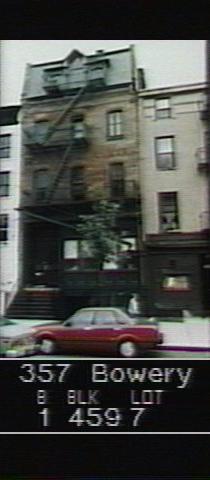
The city photographed every building for its tax records around 1940 and again in the 1980s. NYC Municipal Archives.
Written with AI from the source each entry cites, then fact-checked.
- 1870
Architect Carl Pfeiffer files plans for a four-story Bowery branch for Germania Fire Insurance
Carl Pfeiffer filed the building application on June 27, 1870, and builder Marc Eidlitz finished the brick structure in three months. The papers called it an office building, but the Landmarks Commission thinks Germania really meant a tenement with its own office on the ground floor, since that label let it skip the fire escapes required for multiple dwellings. Germania built on land it leased from the surveyor Samuel Stilwell Doughty and never bought the lot.
- 1870
A butcher, a whip-maker and an actress are among nine tenants counted in the new building
The 1870 census, taken less than three months after the building was finished, found nine tenants. They included the butcher William Bennett, the whip-maker Fred Stevens and an actress, Geneva Withers, while William Clifton ran a policy shop that was probably Germania's own office. All but one of the tenants had been born in the United States.
- 1870
Pfeiffer gives a $15,000 tenement-office a mansard-style roof and a cast-iron storefront
Carl Pfeiffer borrowed from the grand insurance headquarters then rising downtown, giving the building a high basement and a sloped, mansard-style roof with a three-part dormer. It cost about $15,000, roughly one-third of Germania's five-story headquarters at 175 Broadway, and it was faced in Philadelphia brick rather than costlier iron or stone. The simple Italianate cast-iron storefront carries the foundry mark of Boyce & McIntire.
- 1886
A customer's friend tries to throw a dentist through his shop window over a false tooth
After Germania moved away, a dentist took the ground-floor offices. On May 29, 1886, Mary Nelson came back with friends Annie Lawlor and John Hogan because her mended tooth was not ready, and the trio left threatening to return. A policeman hid behind a screen, and when they came back half an hour later Hogan said he would shoot the dentist but had left his pistol at home, then tried to push him through the window. Hogan was held on $500 bail for assaulting the officer, and each woman was fined $10.
Source: Daytonian in Manhattan
- 1904
A young clerk loses $102.50 to the "lemon gag" at the saloon pool table
By February 1904 the old insurance office had become a saloon run by Otto Schmidt, with a pool table. In December 1904 a German clerk named Max Jacoby was drawn into a game there, lost $2.50, then fetched $100 from a bank to double his bet. A man posing as the manager held the stakes, and all three men ran out; when the swindlers were caught, the judge asked Jacoby whether he would have complained had he won, and discharged the prisoner when he said he had not won.
Source: Daytonian in Manhattan
- 1931
Rocco Laraia & Company, a maker of barbershop equipment, moves in and stays four decades
The Laraia and Pellettieri families bought the building in 1929, replaced its rear extension with a full-height one and installed an Otis freight elevator. In 1931 Rocco Laraia & Company, which manufactured equipment for barbershops and beauty parlors, moved in and remained into the early 1970s, briefly under the name Laraia & Pellettieri in the 1950s. Over the years it shared the building with a roofer, an upholsterer, a mirror company and a wire-products company.
- 1979
Ingo Swann, a creator of "remote viewing," buys the building with a partner
As artists and musicians rediscovered the Bowery in the 1970s, former factory spaces here were quietly lived in again. One resident, the artist Ingo Swann, bought the building in 1979 together with Warren E. Spieker Jr. Swann was also an author and psychic who helped devise remote viewing, in which a subject mentally describes a place knowing only its geographic coordinates, a practice that interested the CIA.
Source: Daytonian in Manhattan
- 2010
The Landmarks Commission designates the Germania building after a hearing with six speakers in favor
The Landmarks Preservation Commission designated the Germania Fire Insurance Company Bowery Building a New York City landmark on March 23, 2010. At the June 23, 2009 hearing, six speakers backed designation, including the author Joyce Mendelsohn and representatives of the Bowery Alliance of Neighbors and the East Village History Project. The owners' representatives spoke neither for nor against it.
“March 23, 2010, Designation List 427 LP-2354 ... There were six speakers in favor of designation…”
Further reading
- 357 BoweryVillage Preservation: East Village Building Blocks
Nearby
- 54 East 4th Street3 entries
- 56 East 4th Street2 entries
- 4th Street Food Co-op58 East 4th Street | 3 entries
- 57 East 4th Street1 entry
- 60 East 4th Street1 entry
- 59 East 4th Street3 entries