Banta Building (357-359 Canal Street)
357 Canal Street | also 1 Wooster Street | SoHo | built 1855
Open on the map5 entries

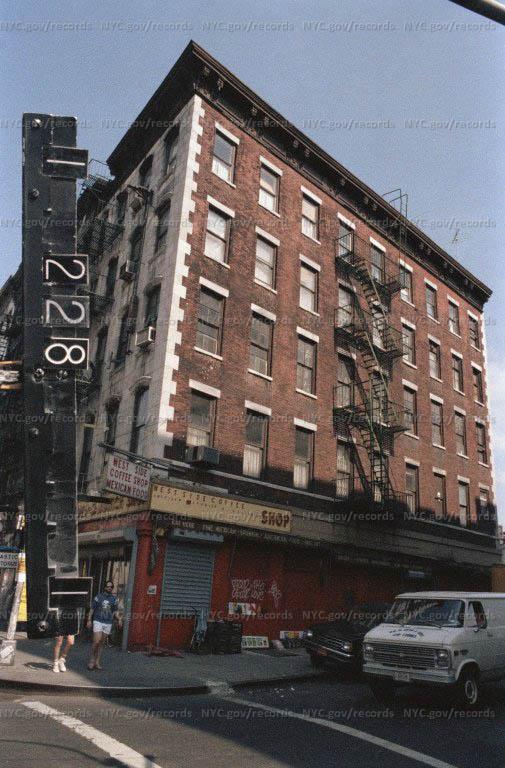
The city photographed every building for its tax records around 1940 and again in the 1980s. NYC Municipal Archives.
Written with AI from the source each entry cites, then fact-checked.
- 1855
Hatter William Banta and Asher Rosenblatt replace two old houses with matching marble-fronted stores
Banta ran a hat store in a converted house at the corner of Canal and Wooster, with Rosenblatt's fancy-goods shop next door. They hired architect W. T. Beers to replace both with twin Second Empire buildings, finished in late 1855, faced in white marble above cast-iron storefronts. Banta advertised his opening on March 18, 1856, and let the upper floors to a flower dealer and a trunk seller.
Source: Daytonian in Manhattan
- 1870
A lace importer at 359 Canal loses $1,500 in goods to rear-entry thieves
A police officer came across four bags of lace in the hallway of 17 Wooster Street on the morning of September 20, 1870. Investigators traced them to the shop of importer J. Connor at 359 Canal, which had been entered from the back. Connor hurried to the Prince Street station and identified every bag as his. The haul was worth over $30,000 today, and no trace of the thieves was found.
Source: Daytonian in Manhattan
- 1956
Artist Romare Bearden moves into a loft at 357 Canal Street and stays for the rest of his life
Bearden and his wife, the model, dancer and choreographer Nanette Rohan, whom he had married in 1954, moved to a loft here in 1956. The foundation's chronology records it as his home for the rest of his life.
Source: beardenfoundation.org
- 1963
Bearden invites artists to his Canal Street studio, leading to the Spiral group
In 1963 Bearden asked fellow artists to meet at his studio to talk about political events tied to the civil rights movement. The conversations grew into Spiral, a collective that set out to ask 'What is Black art?' It soon rented a space on Christopher Street, met weekly, planned exhibitions and arranged to attend the August March on Washington.
Source: beardenfoundation.org
- 1977
The New York Times points movers to Amplest Inc. at 359 Canal for Bubble Wrap
By the 1970s this stretch of Canal Street was unofficially the plastics district, and Amplest Inc. occupied the ground floor of 359. On January 5, 1977, the New York Times recommended the shop to readers about to move as a source of Bubble Wrap. Artists were also living in the upper floors, and one of them, Vita Giorgi, joined the 1971 'Ten Downtown' loft show.
Source: Daytonian in Manhattan
Further reading
- the 1855 Marble-fronted 357 and 359 Canal StreetDaytonian in Manhattan
Nearby
- 359 Canal Street1 entry
- 361 Canal Street1 entry
- 363 Canal Street1 entry
- 353 Canal Street1 entry
- Webb Building (365-367 Canal Street)365 Canal Street | 4 entries
- Canal Projects NY351 Canal Street | 1 entry