Baptist Temple
360 Schermerhorn Street | also 356 Schermerhorn Street | Boerum Hill | built 1894
Open on the map7 entries

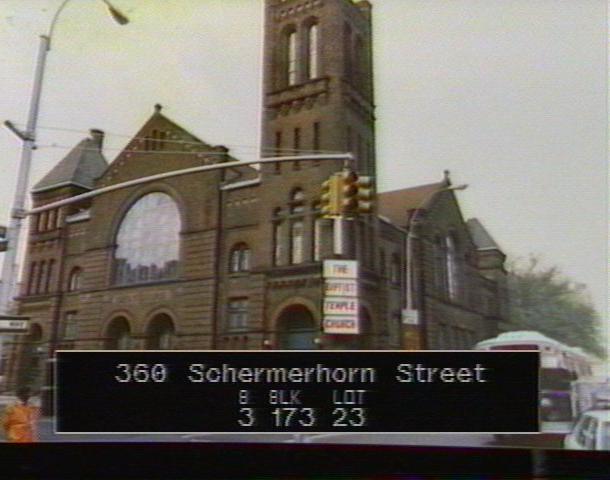
The city photographed every building for its tax records around 1940 and again in the 1980s. NYC Municipal Archives.
Written with AI from the source each entry cites, then fact-checked.
- 1894
The oldest Baptist congregation in Brooklyn builds the Baptist Temple at Third Avenue and Schermerhorn Street
First Baptist Church of Brooklyn was founded in 1823 and had joined with the Pierrepont Street Baptist congregation in the Heights. After outgrowing that building, it sold its Pierrepont and Clinton Streets corner to the Brooklyn Savings Bank in 1892 and went looking for a new site. It chose this corner, where the Long Island Rail Road and the junction of the elevated and trolley lines met, and the Baptist Temple was built in 1893-1894.
Source: brownstoner.com
- 1894
Weary & Kramer design the Baptist Temple as an auditorium church with moveable seats instead of pews
The building committee weighed designs by the Parfitt Brothers, Frank Freeman and an architect named Hubbard before choosing Weary & Kramer. George Kramer favored the auditorium plan, with seating curved around the pulpit, a large baptismal pool and Sunday school rooms ringing the upper level. The church never had pews and used individual seats that could be rearranged. The exterior combined brick, brownstone, terra-cotta and stained glass.
Source: brownstoner.com
- 1894
Organist Edward Morris Bowman begins twelve years leading a chorus and orchestra that gains a national name
Edward Morris Bowman was the first organist and choirmaster of the church. From 1894 to 1906 he directed a large chorus and orchestra there, and the group became known across the country.
“Edward Morris Bowman was the church's first organist and choirmaster. He led a large chorus and orchestra at the church from 1894-1906 that gained a national reputation.”
Source: Wikipedia
- 1917
A fire guts the church, and Dodge & Morrison rebuild it with a Steere & Son organ
A fire in 1917 destroyed the whole interior along with the rose window and the roof. The congregation hired Dodge & Morrison, who rebuilt the church with easier entrances and exits and a higher ceiling; only the baptismal pool survived from the original interior. A large J. W. Steere & Son organ was installed, and the church reopened in 1918.
Source: brownstoner.com
- 1995
Organ restorer Keith Bigger moves into the church to rebuild its Steere organ for the cost of parts
The National Register of Historic Places added the church to its list in 1995. That same year the Steere organ was partway through a multi-year restoration by Keith Bigger, who requested only enough money for parts. He took up residence in the church beside the instrument and began patching the leaking roof as well.
Source: brownstoner.com
- 2010
A three-alarm fire badly damages the church interior and its pipe organ
A three-alarm fire broke out at the church on July 7, 2010, and the building was seriously damaged. The interior suffered most, especially the historic pipe organ, whose multi-year restoration had not been finished.
Source: brownstoner.com
- 2022
The congregation becomes nondenominational and renames itself Next Step Community Church
In 2022 the church became nondenominational and evangelical. It took the name Next Step Community Church, which it uses at 360 Schermerhorn Street.
Source: Wikipedia
Further reading
- Next Step Community ChurchWikipedia
Nearby
- The Hub346 Livingston Street | 2 entries
- Khalil Gibran International Academy485 State Street | 2 entries
- Brooklyn Academy of Music30 Lafayette Avenue | 8 entries
- Williamsburgh Savings Bank Tower1 Hanson Place | 10 entries
- Brooklyn Music School126 St Felix Street | 4 entries
- Hanson Place Central United Methodist Church144 St Felix Street | 8 entries