First Church of Christ, Scientist
361 Central Park West | also 1 West 96th Street | Upper West Side | built 1903
Open on the map8 entries

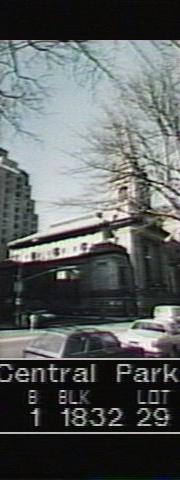
The city photographed every building for its tax records around 1940 and again in the 1980s. NYC Municipal Archives.
Written with AI from the source each entry cites, then fact-checked.
- 1899
Church members lay the cornerstone of the Central Park West church with a letter from Mary Baker Eddy
In 1899 the New York congregation bought the corner of Central Park West and 96th Street, and its leader Augusta Stetson hired Carrère & Hastings, whose Public Library was then rising on Fifth Avenue. The cornerstone went in on November 30, 1899. Sealed inside was a letter from the movement's founder, Mary Baker Eddy, to Stetson, saying she left her name with Stetson's there in unity and love.
Source: Daytonian in Manhattan
- 1903
A $300,000 plan grows into a $1.185 million church of hand-cut Concord granite
The congregation first budgeted $300,000, but the build kept growing. Concord granite from New Hampshire replaced brick and Indiana stone, and it was so hard that it had to be cut by hand. The reading room, Sunday school rooms and offices were moved above the auditorium, three elevators were added, and a costlier tower was ordered. At its 1903 dedication the church had cost $1.185 million and was fully paid for.
Source: Daytonian in Manhattan
- 1903
The church is dedicated debt-free a day after newspapers print an attack on its leader, Augusta Stetson
The church was dedicated on November 29, 1903, with about 1,200 members and an auditorium for 2,200. The day before, most of the morning papers carried an anonymous attack accusing Augusta Stetson of acting as a dictator within the congregation. The Evening World reported that Christian Scientists across the city were indignant, an early sign of the friction between Stetson and the Boston headquarters.
Source: Daytonian in Manhattan
- 1903
John La Farge's stained-glass window of Jesus and Mary in the garden fills the church entrance
The landmark report credits the artist Charles H. Cottrell with the interior decoration. Above the entrance door, the painter John La Farge designed a large stained-glass window showing Jesus and Mary in the garden after the Resurrection. The window sits in a deeply recessed opening below an ornate cartouche and between Ionic columns, and it is the feature that gives the east front its striking note.
“…designed the large stained glass window above the entrance door , depicting Jesus and Mary in the Garden after the Resurrection…”
- 1909
The Mother Church excommunicates Augusta Stetson, barring her from the church she built
Stetson had planned a grand second church on Riverside Drive in 1908, which Boston forbade. On November 19, 1909, the New-York Tribune headlined 'Mrs. Stetson Out': the Mother Church excommunicated her, charging malpractice and putting personality above principle. She kept preaching to followers called Stetsonites from her house next door, watching worshippers file into the church she could no longer enter.
Source: Daytonian in Manhattan
- 1921
A court halts a 15-foot wall the church planned between its property and Stetson's marble house
After courts ordered the 'Stetsonites' reinstated in 1920, the church planned a wall along the boundary, since Stetson's iron fence straddled the property line. Letters between the two sides leaked to the press. In September 1921 workmen appeared, and Stetson's lawyer called the 15-foot wall a spite fence and won a restraining order. The judge said it would serve no useful purpose.
Source: Daytonian in Manhattan
- 1989
A man throws rocks through the church's stained-glass windows, causing up to $20,000 in damage
In 1989 Larry Hogue, a homeless man from the neighborhood whose mental illness had worsened over years, began smashing rocks through the stained-glass windows of the church. The damage ran between $10,000 and $20,000. By 1993 the congregation, down to about 30 or 40 people on Sundays, was still repairing the windows and the granite steeple, and the Landmarks Conservancy gave it an $80,000 grant to assess repairs.
Source: Daytonian in Manhattan
- 2018
The Children's Museum of Manhattan buys the former church after a condo plan stalls
The Children's Museum of Manhattan announced in January 2018 that it had acquired the former church for $45 million, with $5.5 million from the city toward renovation. Before that, a developer paid $26 million for the building in 2014 and planned condominiums, but the zoning board of appeals rejected the plan. FXCollaborative's design, which drew neighbors' objections over a rooftop penthouse and window removals, won approval in June 2020.
Source: Wikipedia
Further reading
Nearby
- The Turin333 Central Park West | 3 entries
- Columbia Grammar & Preparatory School5 West 93rd Street | 7 entries
- The El Dorado300 Central Park West | 11 entries
- The Nippon Club161 West 93rd Street | 4 entries
- Frederick Douglass Houses840 Columbus Avenue | 5 entries
- Trinity School139 West 91st Street | 9 entries