364 Van Duzer Street House
364 Van Duzer Street | Stapleton | built 1835
Open on the map3 entries

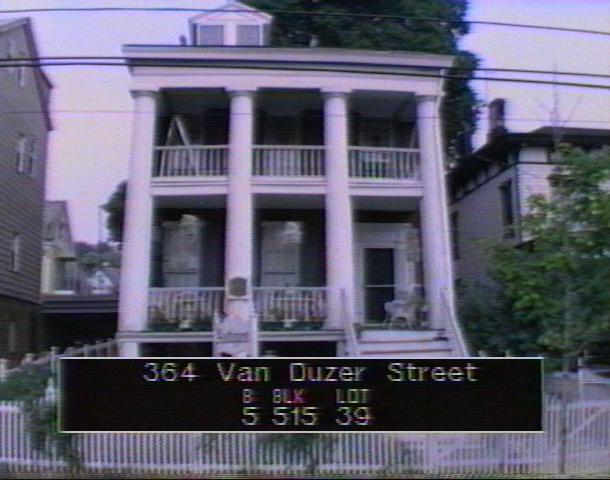
The city photographed every building for its tax records around 1940 and again in the 1980s. NYC Municipal Archives.
Written with AI from the source each entry cites, then fact-checked.
- 1834
Ferry captain Robert M. Hazard buys the lot and soon puts up the house
Minthorne Tompkins and William J. Staples purchased land from the family of Cornelius Vanderbilt in 1833, then surveyed and cut it into lots for the new village of Stapleton. In September 1834 this lot went to Robert M. Hazard, a onetime sailmaker who was master of Daniel Tompkins's ferry Nautilus and served as postmaster of Tompkinsville. Hazard had the house built shortly afterward.
“…in September 1834, the lot of number 364 VanDuzer Street was sold to Robert M. Hazard, who soon afterwards had the present house built.”
- 1835
A Greek Revival portico rises under a Dutch-style spring eave
The frame house, put up around 1835, fronts the street with a four-column portico of Doric columns two stories tall, topped by an overhanging curved spring eave instead of the usual triangular gable. The Landmarks Preservation Commission called the pairing unusual: the flared eave is a feature linked to Dutch Colonial building in New Netherland, which Staten Island builders kept using well into the 19th century. Tall windows and light railings at the parlor and second floors open onto the porch.
- 1973
The city designates the house a landmark as one of Stapleton's first homes
After a July 24, 1973 hearing at which five witnesses, the owner's representative among them, spoke for it and nobody spoke against, the Landmarks Preservation Commission designated the house on December 18, 1973. The commission called it one of the earliest houses in Stapleton, a village that went on to become one of Staten Island's most important, and a fine example of a building style it said was native to the island and found nowhere else.
Nearby
- 390 Van Duzer Street House390 Van Duzer Street | 3 entries
- Mary and David Burgher House63 William Street | 4 entries
- St. Paul's Memorial Church219 St Pauls Avenue | 3 entries
- Staten Island Savings Bank Building81 Water Street | 4 entries
- Edgewater Village Hall111 Canal Street | 3 entries
- Audre Lorde Residence207 St Pauls Avenue | 4 entries