Broadway Textile Building
366 Broadway | also 2 Cortlandt Alley, 364 Broadway | Civic Center | built 1909
Open on the map5 entries

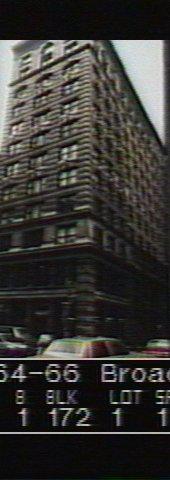
The city photographed every building for its tax records around 1940 and again in the 1980s. NYC Municipal Archives.
Written with AI from the source each entry cites, then fact-checked.
- 1909
Louis M. Jones & Co. completes a 12-story Beaux-Arts office building at Broadway and Franklin
Louis M. Jones & Co. cleared the old structures from the corner and built this twelve-story office building to designs by Frederick C. Browne, finishing it in 1908-09. The lot is roughly 50 feet wide on Broadway and reaches 150 feet back along Franklin Street to Cortlandt Alley, and the facades are brick and limestone with terra-cotta trim. The Landmarks Commission lists it as the Broadway Textile Building or Broadway-Franklin Building. Applied letters on the frieze still spell out the name of the dry goods firm Bernard Semel, Inc.
- 1909
Royal Typewriter takes the store and offices, and the building is to bear its name
The Royal Typewriter Company took the ground-floor store and space above for its salesroom and executive offices; the company had sold its first typewriter only three years earlier. The New York Times reported on March 12, 1909 that the building would be known as the Royal Typewriter Building. Rival Elliott-Fischer Co. took the entire fifth floor that fall. Over the next decade the building filled with knitwear, yarn and underwear firms, including the New York office of Hanes.
Source: Daytonian in Manhattan
- 1911
State officials refuse a restaurant the corporate name "Hell"
The law firm Goldstein & Goldstein, which kept offices here for years, filed incorporation papers for a restaurant client that wanted to be called "Hell." Secretary of State Lazansky refused. The New York Times reported on September 9, 1911 that officials assumed the owners wanted the publicity of an electric sign bearing the name, and held that the word was against public policy. The firm went on to handle several high-profile murder cases from these offices.
Source: Daytonian in Manhattan
- 1914
The Associated Press sets a trap with a fake warship story from an office here
Suspecting that a small news agency was stealing its dispatches, the Associated Press had a detective rent an office at 366 Broadway and install a New York News Bureau ticker. On November 27, 1914 the AP sent a false story that a Russian warship, the Fliba, had been sunk with 450 men. Ten minutes later it appeared on the ticker, and two hours after that an evening paper ran it. Henry L. Linder, a Postal Telegraph operator, was arrested for revealing a telegraphic message.
Source: Daytonian in Manhattan
- 1979
The textile building is converted into 38 co-op apartments called the Collect Pond House
The building's character had shifted long before: in the 1930s it was headquarters of the State Labor Relations Board, which held collective bargaining meetings there, though most tenants were still textile and apparel firms. As Tribeca turned toward restaurants and loft living, the Broadway Textile Building was converted in 1979 into 38 cooperative apartments named the Collect Pond House.
Source: Daytonian in Manhattan
Nearby
- Mmuseumm368 Broadway | 10 entries
- Sargent's Daughters370 Broadway | 2 entries
- Anat Egbi372 Broadway | 3 entries
- 54 Franklin Street4 entries
- Mandarin Plaza376 Broadway | 2 entries
- Mudd Club building77 White Street | 5 entries