Gerken Saloon Building
385 Avenue of the Americas | also 135 Waverly Place | West Village | built 1877
Open on the map5 entries

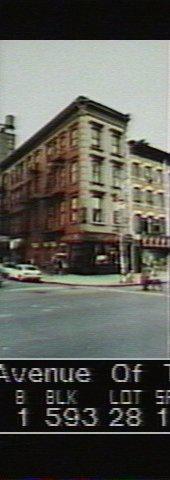
The city photographed every building for its tax records around 1940 and again in the 1980s. NYC Municipal Archives.
Written with AI from the source each entry cites, then fact-checked.
- 1877
D. & J. Jardine design a flats building with a liquor store below for Carsten Gerken
Carsten Gerken, who lived in the building and kept his liquor store on the ground floor facing the Avenue, commissioned architects D. & J. Jardine to design this corner house in 1877. It was planned for three families, with the apartments entered from Waverly Place at No. 135. The landmarks report notes Queen Anne touches, including a sunburst motif on the cornice fascia and in the large corner brackets.
“…erected for Carsten Gerken, who lived here and had his liquor store below, on the Avenue.”
- 1877
The Gerken brothers run a corner saloon by unusually strict rules
Carsten Gerken and his brother John kept their saloon within the letter of the law, according to The Sun. Women were barred from the back room, and only women known as respectable neighbors could have a pail of beer filled at the side vestibule. The brothers refused beer to men whose wives came looking for them. On summer nights they set chairs under the tree on Waverly Place for evening beer and Rhine wine, and neighbors also used the saloon as an informal employment agency.
Source: Daytonian in Manhattan
- 1879
Comedian Tony Hart and a Theatre Comique treasurer are among the first tenants
Several early tenants came from the theater world. In 1879 they included actor William Gray; John E. Cannon, the treasurer of the Theatre Comique, which stood at 514 Broadway; and Anthony J. Cannon, who performed as Tony Hart. Hart was half of the comedy team Harrigan & Hart, which was appearing at the Theatre Comique at the time.
Source: Daytonian in Manhattan
- 1905
Members of the Paul Kelly Gang brawl at the saloon and threaten the policeman who arrests one
Its reputation slipped once Ella Gerken rented the saloon to Charles Neubaur. The New York Evening Post reported on August 18, 1905, that a crowd of roughs thought to belong to the Paul Kelly Gang was thrown out of the bar, came back, and started a free-for-all. Policeman Francis J. Upton arrested one man after a hard fight in which he was struck with a brass knob. Upton later showed a magistrate a letter from the gang saying they would lay for him.
Source: Daytonian in Manhattan
- 1926
Lightning strikes the penny arcade in the former saloon during a citywide storm
By 1924, during Prohibition, the old saloon space had become a penny arcade. During a violent series of thunderstorms on August 12, 1926, lightning hit the arcade at 385 Sixth Avenue, and the scare was enough that someone rang in a fire alarm. The New York Times reported that no damage was done.
Source: Daytonian in Manhattan
Further reading
- The 1877 Gerken Saloon Building - 385 Sixth AvenueDaytonian in Manhattan
- Then & Now photos: 385 Sixth Avenue (aka 135 Waverly Place)Village Preservation: Greenwich Village Then & Now
Nearby
- 387 Avenue of the Americas1 entry
- 389 Avenue of the Americas2 entries
- 391 Avenue of the Americas1 entry
- 141 Waverly Place2 entries
- 395 Avenue of the Americas1 entry
- Henry Luhrs House7 Gay Street | 5 entries