39 Walker Street
also 39A Walker Street | Tribeca | built 1868
Open on the map6 entries

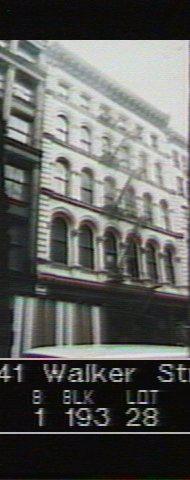
The city photographed every building for its tax records around 1940 and again in the 1980s. NYC Municipal Archives.
Written with AI from the source each entry cites, then fact-checked.
- 1868
John R. Ford replaces two frame buildings with a marble Italianate loft at 39-41 Walker Street
John R. Ford, a Fifth Avenue resident in the india-rubber business, put up this five-story building in 1867-68, replacing two two-story frame buildings. The architect has not been identified. A cast-iron ground floor with Corinthian columns, remarkably intact, supports four stories of marble with arched windows and a bracketed metal cornice.
- 1890
Wirths Brothers, makers of fringed and satin Christmas cards, move in
German-born engravers Colvert and Robert Wirths moved their art-goods business into 39-41 Walker Street in 1890. The firm printed calendars, small illustrated books and Christmas cards, and it set itself apart by adding fringe, lace, glitter and painted satin to its cards. Wirths Brothers showed work at the 1893 World's Columbian Exposition, printed war souvenirs after the sinking of the Maine in 1898, and closed in 1902.
Source: Daytonian in Manhattan
- 1910
Shirtwaist maker Abraham Sitomer sues Alva Belmont and other suffragists over a strike
Abraham Sitomer's shirtwaist factory here had about 200 women workers in the Waistmakers' Union. After a walkout in 1909, the union resumed the strike when it learned he was selling to employers still being struck, and he won a restraining order in January 1910. That June he sued a group of women from the votes-for-women movement, among them Alva Belmont, for $50,000 in damages, a case that drew wide press attention.
Source: Daytonian in Manhattan
- 1910
A trunk sold wholesale from 39-41 Walker Street becomes a clue in a peddler's murder
Elderly jewelry vendor Moses Sachs was robbed, strangled and stuffed into a trunk on June 17, 1910, and his body was found in a hallway the next morning. When police circulated a description of the trunk, Jacob J. Eichner of the New York Suit Case Co., which was in the building, recognized it as a style he sold wholesale to roughly 200 Jewish and Italian dealers around the city. The information he gave led detectives toward the Lower East Side, where peddlers were plentiful.
Source: Daytonian in Manhattan
- 1920
Ray Wilner Sundelson, the 'First Lady of Life Insurance,' owns the building
By the 1920s the Ford estate had sold the property to Ray Wilner Sundelson. A Russian-born woman (1874-1951), she became the Equitable Life Assurance Society's first female general agent and sat on its Board of Managers, which earned her the nickname 'The First Lady of Life Insurance.'
Source: Daytonian in Manhattan
- 1975
A prisoner on the run is tracked into 39-41 Walker Street and slips away
On February 18, 1975 inmate Harry W. Whatley, 29, bolted from an officer after being taken to the Criminal Courts Building, and vanished. About 50 police with automatic rifles searched the area for nearly two hours. Captain McPherson followed him to 39-41 Walker Street and tried to talk him into surrendering, but Whatley refused and escaped through another exit, and the search was called off around 10:20 a.m.
Source: Daytonian in Manhattan
Further reading
- Christmas Cards, Sponges and Arson - 39-41 Walker StreetDaytonian in Manhattan
Nearby
- 37 Walker Street2 entries
- 45 Walker Street3 entries
- Icabod Price House35 Walker Street | 5 entries
- 38 White Street1 entry
- 293 Church Street4 entries
- Pottier Building47 Walker Street | 5 entries