6 Weehawken Street (Weehawken Market remnant)
392 West Street | also 6 Weehawken Street, 393 West Street | West Village | built 1834
Open on the map12 entries

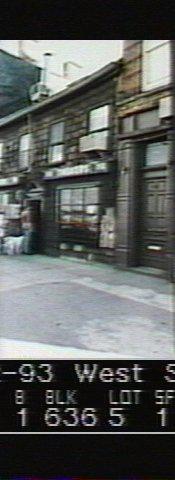
The city photographed every building for its tax records around 1940 and again in the 1980s. NYC Municipal Archives.
Written with AI from the source each entry cites, then fact-checked.
- 1797
Newgate State Prison, New York's first, rises on the site
Before any of today's wooden buildings stood here, this land belonged to Newgate State Prison, a four-acre complex built in 1796-97 to designs by Joseph-Francois Mangin. It was the first state prison in New York, enclosed by high stone walls and stretching between today's Christopher and Perry Streets to the Hudson shore. Ferry service from the prison dock to Hoboken began in 1799, and visitors came to look at the place.
“…the 4-acre State Prison at Greenwich, or Newgate State Prison, constructed in 1796-97 to the design of architect Joseph-Francois Mangin…”
- 1829
Newgate closes and the city saves the West Street frontage for a market
The state's prisoners were moved up the Hudson to Sing Sing in 1828-29, after former mayor Stephen Allen, appointed a commissioner in 1824, recommended closing Newgate. The city, which had acquired the prison in 1826, platted the land and sold it in 1829. It held back the West Street frontage between Christopher and Amos (now West 10th) Streets for a public market, the origin of this building.
- 1834
The city builds the Greenwich (Weehawken) Market on the old prison land
The city put up the market in 1834 for $3,475, officially calling it the Greenwich Market and informally the Weehawken Market. Landmarks researchers believe this building is almost certainly its sole survivor. The market sold meat, fish, fruit and vegetables but never did well, and it was abandoned in 1844.
“…almost certainly the sole surviving portion of the market house of the Greenwich Market (known unofficially as the Weehawken Market) that was constructed by the City in 1834 for $3475…”
- 1848
Boatbuilder George Munson buys the abandoned market shed at auction
When the city auctioned off the abandoned market in April 1848, divided into seven lots, Lot 5 went to boatbuilder George M. Munson for $1,550. He most likely enclosed the open shed and added a full second story with an outside stair on the Weehawken Street side.
“Lot 5 (No. 392-393 West Street) was sold for $1,550 to George M. Munson, a boatbuilder…”
- 1849
The Littles move in, running the district's earliest documented liquor business
From 1849 to 1867 Robert and Rosanna Little lived and worked here, listed at various times as selling clothing, porter, liquor, fruit and candy. The commission calls it the earliest documented liquor or saloon business in any building of the historic district. Such taverns would remain the district's dominant trade and a center of social life for the waterfront's working men.
- 1893
Harper's writer Thomas Janvier gives the shed a false pedigree back to 1796
As artists and writers began to notice Weehawken Street's picturesque wooden survivors in the 1890s, Thomas A. Janvier wrote about them in Harper's New Monthly Magazine in 1893. He claimed the houses stood as early as 1796 and might appear on a 1767 map. That unsupported age became a lasting myth, though the Landmarks Commission traces the building to the city's market of 1834.
“Janvier asserted that these houses were standing, certainly, as far back as 1796 - as is shown on the Commissioner's map…”
- 1906
James Mulqueen is arrested on a charge of running a gambling house here
The Mulqueen family ran a saloon and later a pool hall here from 1883 to 1907. In 1906 James A. Mulqueen, presumably a son of the original owners, was arrested on a charge of operating an illegal gambling house in the building. The next year Jeremiah Cummings briefly took over the liquor business.
“James A. Mulqueen, presumably a son, was arrested in 1906 for allegedly running an illegal gambling house here…”
- 1909
Billy Gillespie runs a saloon here, later known as Billie's Original Clam Broth House
William F. (Billy) Gillespie began running a liquor and saloon business here in 1909. After Prohibition began, it apparently operated as Billie's Original Clam Broth House, a business that continued until 1925. The earliest known photograph of the West Street side, from 1920, shows two projecting storefront bays and a steep roof with a wide overhang largely hidden by signs.
- 1943
Retired Maine mariner George Hunt buys the building and sells goods to dockworkers
George W. Hunt, a retired sailor from Maine who liked the old building, bought it in 1943 for cash. A 1945 profile in The Villager described him selling work clothes, gloves, tobacco and assorted odds and ends to seafarers and dock workers. He replaced the projecting storefront bays on West Street with flush show windows and enclosed the stair wall on the Weehawken Street side.
- 1960
Attorney Carmine Calarco buys the building and covers it in cedar shingles
Carmine Leo Calarco, an attorney involved in Democratic politics in Greenwich Village, bought the property in 1960 and around 1961 covered it in cedar shingles. In 1966 he represented two men who sought to stop the Landmarks Commission from designating the Greenwich Village Historic District. He moved to MacDougal Alley in 1973, telling the Times he liked being in a landmark district.
- 1972
Choo Choo's Pier opens, followed by the leather bar Sneakers
By 1972 the building housed Choo Choo's Pier, a gay bar catering to leather-and-denim customers. In the late 1970s it became Sneakers, another gay bar, which stayed open until 1999.
“By 1972, this was Choo Choo's Pier, a gay bar with a leather/ denim clientele. In the late 1970s-90s, it was the gay bar Sneakers.”
- 2016
Louise Bourgeois's son announces plan to give the house to the Lenape Nation
The son of artist Louise Bourgeois bought the building in 2006 for $4 million. In 2016 he announced that he would donate it to the Lenape Nation, to be renovated as a prayer house. When Ephemeral New York reported on it in 2017, the house appeared empty, with graffiti on its Hudson River side.
Source: Ephemeral New York
Further reading
- The many lives of an 1834 wooden Village houseEphemeral New York
- Weehawken Street’s sloped-roof houseEphemeral New York
Nearby
- 391 West Street4 entries
- 395 West Street3 entries
- Jacob P. Roome House7 Weehawken Street | 5 entries
- 5 Weehawken Street2 entries
- 187 Christopher Street3 entries
- 185 Christopher Street3 entries