393 Broadway
Tribeca | built 1869
Open on the map3 entries

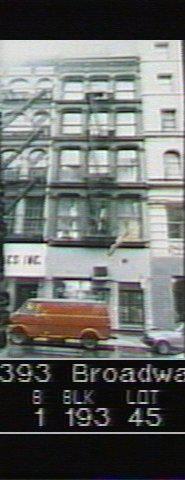
The city photographed every building for its tax records around 1940 and again in the 1980s. NYC Municipal Archives.
Written with AI from the source each entry cites, then fact-checked.
- 1869
Nicholas Whyte designs a Second Empire cast-iron store at 393 Broadway for William Montross
Read more
Nicholas Whyte designed this five-story, 25-foot-wide store, built by J. T. Smith in 1868-69. It replaced an older three-story masonry building, plus a rear structure that insurance maps flagged as used for hazardous purposes. The client, William Montross, was probably a dry-goods merchant of the neighborhood who had earlier partnered in Montross & Wilson. The cast-iron Second Empire facade has molded arched openings flanked by piers and metal stringcourses, and a cast-iron column survives at the base behind a modern storefront.
- 1890
John W. Love buys 393 Broadway from the Spencers, and his family keeps it for more than 50 years
On December 12, 1890, Lorillard Spencer Jr. and his wife Caroline sold the building to John W. Love for $125,000, which was $10,000 more than Spencer had paid the estate of Catherine Lorillard Spencer after her death in 1882. Hall's Safes of Cincinnati opened a store here in 1898, and Love added a new elevator shaft in 1901. The Love family held the property until December 1941; the Times noted that the sellers had owned it for more than half a century.
Source: Daytonian in Manhattan
- 1906
Ch. Weiss promotes the Pipeolion from 393 Broadway, an instrument advertised as easy for any child to learn
In 1906 Ch. Weiss, a musical-instrument firm, shared 393 Broadway with Hall's Safes, a dry-goods firm, a hosiery dealer and an upholstery company. Weiss made instruments it promised parents their children could pick up easily. Its advertisement for the Pipeolion claimed that a child able to count could learn to play it, and the instrument was touted as able to imitate everything from a cornet to a pipe organ. The firm stayed in the building at least through 1912.
Source: Daytonian in Manhattan
Nearby
- 391 Broadway3 entries
- Equitable Life Assurance Building395 Broadway | 3 entries
- Grosvenor Buildings385 Broadway | 3 entries
- 59 Walker Street2 entries
- Grosvenor Building66 White Street | 4 entries
- David Lewis Gallery57 Walker Street | 1 entry