Audubon Ballroom
3940 Broadway | Washington Heights | built 1900
Open on the map13 entries

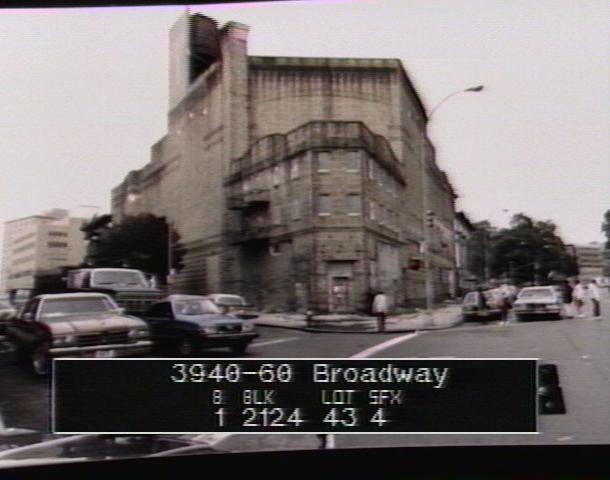
The city photographed every building for its tax records around 1940 and again in the 1980s. NYC Municipal Archives.
Written with AI from the source each entry cites, then fact-checked.
- 1912
William Fox opens the Audubon Theatre and Ballroom
Film producer William Fox commissioned Thomas W. Lamb to design the building, which opened in 1912 with a 2,500-seat theater and a second-floor ballroom. Over the following decades it served as a vaudeville house, a movie theater and a meeting hall for political groups and trade unions.
Source: Wikipedia
- 1912
Thomas Lamb gives the Audubon a polychrome terra-cotta facade of foxes and Neptune
Architect Thomas W. Lamb, who liked to use ornament and color on theater exteriors, clad the Audubon in glazed terra cotta in several colors. Foxes sit between the second-floor windows as a nod to owner William Fox, and a three-dimensional Neptune on a ship is the most prominent feature. Lamb held that exotic decoration frees the mind and makes it ready to be entertained.
Source: Wikipedia
- 1950
Congregation Emes Wozedek buys the building for its synagogue
The German-Jewish congregation Emes Wozedek, which had held Sabbath services in the ballroom's basement rooms since the 1930s, purchases the building in 1950. The congregation continues to worship there until 1983, sharing the building over the decades with union meetings and a movie house.
Source: Wikipedia
- 1964
Malcolm X announces his Organization of Afro-American Unity at the ballroom
On June 28, 1964, Malcolm X announced the founding of the Organization of Afro-American Unity at a public meeting in the Audubon Ballroom. He wrote its charter with John Henrik Clarke, Albert Cleage, Jesse Gray, Gloria Richardson and others, modeling it on the Organization of African Unity that had impressed him in Africa. He said it would focus on human rights, voter registration, school boycotts and rent strikes. On July 2 J. Edgar Hoover called it a threat to national security.
Source: Wikipedia
- 1965
Malcolm X is assassinated while speaking at the Audubon Ballroom
After leaving the Nation of Islam, Malcolm X founded the Organization of Afro-American Unity, which held weekly meetings in the ballroom. On February 21, 1965, he was assassinated here while delivering a speech at one of those gatherings.
Source: Wikipedia
- 1967
The city takes the Audubon for unpaid taxes while its theater runs as the San Juan
New York City took possession of the Audubon Ballroom and Theatre in 1967 because of unpaid property taxes. Through the 1960s and 1970s the theater operated as the San Juan Theater, showing films for the neighborhood's growing Hispanic population. It closed in 1980, and the building stood vacant while its exterior deteriorated.
Source: Wikipedia
- 1982
Columbia announces plans to demolish the ballroom for a $22 million science laboratory
In 1982 Columbia University announced that it would tear down the Audubon Ballroom and an adjacent theater and put up a commercial science laboratory, costing $22 million, near Columbia-Presbyterian Medical Center. The buildings were decrepit and largely abandoned, but because Malcolm X was shot there in 1965, many saw the proposal as an act of violence. Protests forced Columbia to rework the plan several times, most recently in 1990.
Source: The New York Times
- 1990
Critics and supporters clash at a hearing on razing the ballroom for a Columbia laboratory
At a City Planning Commission hearing on May 2, 1990, speakers argued over Columbia's plan to replace the abandoned ballroom and theater with a laboratory. Omowale Clay of the Malcolm X Coalition to Save the Audubon Ballroom said the plan desecrated Malcolm X's memory, while speakers from the Municipal Art Society and the Landmarks Conservancy argued that the facade and ballroom could be kept and restored beside the lab. Supporters, including Mayor David Dinkins and the local community board, cited jobs and a memorial to Malcolm X.
Source: The New York Times
- 1992
Preservationists save part of the Audubon Ballroom from demolition
As Columbia University and the Port Authority move to demolish the derelict theater under a 1989 redevelopment deal, preservationists and Malcolm X's family fight to save the site of his assassination. A compromise preserves about two-thirds of the original facade along with the ballroom interior, which is restored as a memorial.
Source: Wikipedia
- 1995
A restored facade fronts a new six-story laboratory, with 40 percent of the assassination room left standing
By June 1995 a $7 million restoration of the terra-cotta facade was finished, and a $28 million, six-story laboratory by Davis, Brody & Associates stood about 15 feet behind it. About 40 percent of the room where Malcolm X was shot remained, sheathed in sheetrock and awaiting a memorial. The architects' photographs showed bullet holes circled in chalk around the podium, and Harlem preservationist Michael Henry Adams still called the partial saving an injustice.
Source: The New York Times
- 2004
Columbia, the city and Malcolm X's family agree to create a memorial center in the ballroom
At a private meeting on December 13, 2004, Columbia University, the city's Economic Development Corporation and Malcolm X's family settled on creating a memorial and educational center named for Malcolm X and Betty Shabazz. Betty Shabazz had led the effort before her death in 1997, and a later city promise of a research center had gone nowhere. Rent from a Chase branch on the site, about $700,000, was to seed the project, and May 19, 2005, Malcolm X's 80th birthday, was the target opening.
Source: The New York Times
- 2005
The Malcolm X and Dr. Betty Shabazz Memorial and Educational Center opens
When Columbia University proposed demolishing the building in 1992 to build a medical research facility, community activists and preservationists fought the plan. A compromise kept about two-thirds of the original facade alongside the new Mary Woodard Lasker Biomedical Research Building, and in 2005 the Malcolm X and Dr. Betty Shabazz Memorial and Educational Center opened here.
Source: Wikipedia
- 2005
On the 40th anniversary, about 400 people are expected at the ballroom's first memorial to Malcolm X
On February 21, 2005, about 400 people were expected at the first memorial held in the ballroom since Malcolm X's death, including three of his six daughters and followers who had watched him die. Ilyasah Shabazz pointed to the spot where she, nearly three years old, had sat in a booth with her sisters and her pregnant mother. Benjamin Kareem, the aide who introduced Malcolm X that day, was returning for the first time.
Source: The New York Times
Further reading
- Audubon BallroomWikipedia
Nearby
- Mary Woodard Lasker Biomedical Research Building3952 Broadway | 6 entries
- Morgan Stanley Children's Hospital3959 Broadway | 6 entries
- Irving Cancer Research Center1130 St Nicholas Avenue | 5 entries
- Russ Berrie Medical Science Pavilion1150 St Nicholas Avenue | 4 entries
- Columbia University Irving Medical Center630 West 168th Street | 7 entries
- Presbyterian Hospital Building622 West 168th Street | 9 entries