397 Bleecker Street
West Village | built 1853
Open on the map4 entries

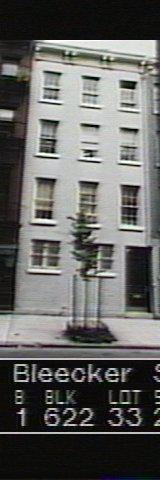
The city photographed every building for its tax records around 1940 and again in the 1980s. NYC Municipal Archives.
Written with AI from the source each entry cites, then fact-checked.
- 1853
Crockery dealer John B. Walton puts up a row of Italianate houses
John B. Walton, a crockery dealer, had the row at Nos. 393-397 built in 1852-53, in a plain version of the Italianate style. No. 397 carries a cornice on paired brackets like that of the corner house, No. 399, which Walton also owned. The ground-floor stores were later turned into apartments.
- 1866
A flour company sues Nelson Beecher for copying a rival's self-raising flour packaging
Nelson Beecher, who lived here when it was numbered 379, had moved his business from feed to flour. In March 1866 Hecker Brothers, makers of the so-called self-raising flour, sued him, claiming his packaging and labels imitated theirs closely enough to cause serious injury. The judge disagreed with them in the end.
Source: Daytonian in Manhattan
- 1929
The row becomes two-family homes called Bleecker Gardens, with a wading pond out back
In 1929 Walton's four houses were turned into two-family homes: the shop fronts were bricked over and every house got two duplex apartments. Called Bleecker Gardens, the group shared a back yard with a wading pond and a children's playground, according to later court papers. Graham R. Taylor, an editor and Commonwealth Fund publications director, lived in one apartment in the 1930s.
Source: Daytonian in Manhattan
- 1956
Landlord Werner Wolff loses a court fight over an illegal conversion and the tenants stay
Werner Wolff bought No. 397 in 1946 and turned the upper duplex into two units without plans or city approval. When he tried to evict the top-floor tenant in 1954, the case drew in the Department of Buildings. Wolff was fined, and in 1956 the court let the tenants stay, saying a landlord cannot use removal of tenants to fix a predicament he created himself.
Source: Daytonian in Manhattan
Further reading
- The 1853 Nelson Beecher House - 397 Bleecker StreetDaytonian in Manhattan
- Then & Now photos: 397 Bleecker StreetVillage Preservation: Greenwich Village Then & Now
Nearby
- 395 Bleecker Street1 entry
- Magnolia Bakery286 West 11th Street | 6 entries
- 393 Bleecker Street3 entries
- Roger and Evelyn Baldwin House282 West 11th Street | 5 entries
- 391 Bleecker Street1 entry
- 389 Bleecker Street1 entry