John Schermerhorn Bussing House
4 East 12th Street | Greenwich Village | built 1900
Open on the map5 entries

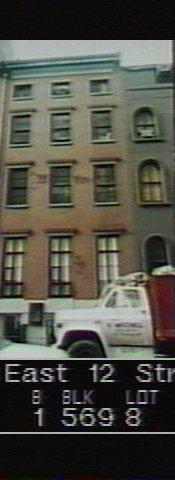
The city photographed every building for its tax records around 1940 and again in the 1980s. NYC Municipal Archives.
Written with AI from the source each entry cites, then fact-checked.
- 1845
Iron merchant John Schermerhorn Bussing builds a brownstone-faced house with a twin next door
Around 1845 John Schermerhorn Bussing, who ran an iron and nail firm, and Peter R. Bonnet began building matching brownstone-faced houses at what were then 154 and 156 Twelfth Street, renumbered 4 and 6 East 12th in 1855. Each was 25 feet wide and four stories tall above an English basement, with a portico of fluted columns topped by palm-leaf capitals. Bussing died here on June 9, 1864; his widow, Ann, lived on until 1905, and their daughter Mary sold the house in 1918.
Source: Daytonian in Manhattan
- 1920
Two bachelor-apartment tenants are mobbed at a rally after a muttered remark is misheard
Engineer Joseph P. Dugan and D. Frank Gordon, early tenants of the new bachelor apartments, attended a rally for gubernatorial candidate Dudley Field Malone near the Maine Monument on October 25, 1920. Dugan murmured to Gordon that the speaker was poor and he wished Malone would hurry up. An Irishman in the crowd of 5,000 Irish sympathizers took it as a curse on the former Lord Mayor MacSwiney of Cork. A mob beat both men, and Dugan nearly lost his life before police rescued them.
Source: Daytonian in Manhattan
- 1927
The Institute of World Unity moves in to promote racial tolerance and peace
The newly formed Institute of World Unity took space here in 1927, probably at basement level. The educational and cultural group aimed to promote racial tolerance and international peace, and by 1930 it was publishing World Unity Magazine from this address. Around 1931 it was followed by The Meeting Place, Inc., and a 1934 renovation by architects Beineix & Snyder gave that group the basement and first floor, with apartments above.
Source: Daytonian in Manhattan
- 1933
Painter Reginald Marsh moves into the newly converted apartments
Reginald Marsh, recently divorced, arrived in the building in February 1933 among the first tenants of the renovated apartments. A Paris native, born in 1898, he became known for pictures of New York life, such as unemployed men on the Bowery and crowds at Coney Island. He married the painter Felicia Meyer in January 1934, and the couple moved out, but his address was still given as 4 East 12th Street in 1937, when he won a cash prize at the National Academy of Design's annual exhibition. He apparently kept his studio here.
Source: Daytonian in Manhattan
- 1950
Composer Marc Blitzstein of The Cradle Will Rock lives in a second-floor apartment
Village Preservation says composer, lyricist and librettist Marc Blitzstein lived at No. 4 from the 1950s until his death. He is best known for The Cradle Will Rock, the pro-union musical directed by Orson Welles that the Works Progress Administration shut down, and for his English adaptation of The Threepenny Opera. His apartment was a galley kitchen and bath, a terrace, and one big room holding his bed, piano and work table.
Source: Village Preservation
Further reading
- The John Schermerhorn Bussing House - 4 East 12th StreetDaytonian in Manhattan
Nearby
- Peter R. Bonnett House6 East 12th Street | 5 entries
- 2 East 12th Street3 entries
- Conservative Synagogue of Fifth Avenue11 East 11th Street | 4 entries
- Salmagundi Club47 5th Avenue | 12 entries
- Hotel Alabama15 East 11th Street | 5 entries
- Hotel Van Rensselaer17 East 11th Street | 5 entries