American Radiator Building
40 West 40th Street | also 38 West 40th Street | Midtown | built 1924
Open on the map14 entries

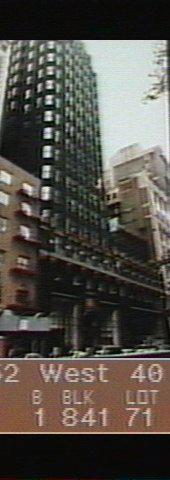
The city photographed every building for its tax records around 1940 and again in the 1980s. NYC Municipal Archives.
Written with AI from the source each entry cites, then fact-checked.
- 1924
The Times reports that over 90 percent of the new tower's floor space is within 25 feet of a window
On January 20, 1924, the New York Times described the new American Radiator Building as a daring break from ordinary office construction. The paper noted the black brick faced the entire tower, with golden-colored trim, and that the design was already provoking discussion among professionals. It also named a practical selling point: more than nine-tenths of the floor space sat within 25 feet of a window.
- 1924
A. D. Juilliard leases the tower's showroom base for a store
In August 1924, A. D. Juilliard signed a lease for about 17,000 square feet at the base of the American Radiator Building. The space took in the multi-level storefront on the ground and second floors plus the rest of the third and fourth floors, all connected by a private elevator. Office tenants included the Clarage Fan Company and the American Engineering Company, and Hood and Fouilhoux's own architecture firm also rented space.
“A.D. Juilliard signed a lease for 17,000 ft2 for a store at the base in August 1924.”
Source: Wikipedia
- 1924
Figures on the third-floor facade recall great moments in the history of steam heat
On the third-floor facade, a series of figures tells a story about the company's trade: one is a pipe fitter, another a man pouring water into a box. Architectural writer Eric Nash reads these figures as references to great moments in the history of steam heat. Nash also describes the lit crown at night as an attention-grabbing metaphor for a company that specialized in home heating.
Source: Ephemeral New York
- 1924
Raymond Hood designs the black-and-gold American Radiator Building
Architects Raymond Hood and Andre Fouilhoux complete a 23-story tower for the American Radiator Company at 40 West 40th Street. Its black brick facade and gilded crown evoke a glowing radiator, blending Gothic and Art Deco styles above Bryant Park.
Source: Wikipedia
- 1925
The Fifth Avenue Association gives the tower a Silver Medal
The Fifth Avenue Association gave a Silver Medal to the American Radiator Building in 1925, the year after the black-and-gold tower was completed on West 40th Street. The Landmarks Preservation Commission cited the award in its 1974 designation report as a measure of the building's excellence. Raymond Hood's firm had designed the tower for the American Radiator Company.
“As a measure of its excellence, the Fifth Avenue Association awarded the American Radiator Building a Silver Medal in 1925.”
- 1927
Georgia O'Keeffe paints the tower's nighttime glow
Viewing the building from her window at the Shelton Hotel, Georgia O'Keeffe paints "Radiator Building-Night, New York," capturing the tower's illuminated crown and black facade glowing above Bryant Park after dark. The painting becomes one of her best-known depictions of the New York skyline.
Source: Ephemeral New York
- 1928
Eleven stories of the tower are lit in the shape of a cross for a tuberculosis campaign
The tower's nighttime lighting was meant to draw attention to its gold-leafed terracotta shaft, but in 1928 it also served a public-health message. Eleven of its stories were lit in the form of a cross to raise awareness of tuberculosis management. Hood had chosen to leave the middle stories of the tower unlit, to avoid any imitation of daylight.
Source: Wikipedia
- 1929
The tower is renamed the American Standard Building
Following a merger between the American Radiator Company and the Standard Sanitary Manufacturing Company, the building at 40 West 40th Street becomes known as the American Standard Building. A five-story annex is added at 50 West 40th Street in 1936 and 1937 to house additional showrooms.
Source: Wikipedia
- 1937
New annex showrooms open with an exhibit on the future of Sixth Avenue
American Standard bought six adjacent houses in 1936 and planned to replace them with a showroom annex west of the tower. The new showrooms opened in June 1937. The first exhibit was a program on the planned redevelopment of Sixth Avenue after the demolition of the Sixth Avenue Elevated, and other displays included "an ideal city of 2000 AD" in 1937 and a model of Sixth Avenue's northern section in 1941.
“The new showrooms of the American Radiator Building opened in June 1937.”
Source: Wikipedia
- 1974
The Landmarks Commission designates the tower after its owner speaks against designation
The Landmarks Preservation Commission held its public hearing on the American Radiator Building on October 8, 1974. One witness spoke for designation, while a representative of the owner spoke against it. On November 12 the commission designated the tower a city landmark, ranking it among Manhattan's most significant skyscrapers, but left out the five-story extension.
“One witness spoke in favor of designation. The representative of the owner spoke in opposition to designation.”
- 1988
American Standard sells the tower and annex to a Japanese company for $43 million
With its New York headquarters staff cut from 500 to 200 within five years, American Standard sold the tower and annex in September 1988 to the Japanese company Clio Court for $43 million. Clio first proposed turning the building into a luxury hotel of 160 to 250 rooms, but the tower stood vacant through the 1990s after Japanese investors lost interest in American real estate.
“American Standard sold the tower and annex to Japanese company Clio Court (also known as Clio Biz) that September for $43 million.”
Source: Wikipedia
- 1994
The tower has stood empty for four years and fashion executives watch Bryant Park shows from it
By the time Christopher Gray wrote about the tower for the New York Times in 1994, the building had been unoccupied for four years. In the 1990s fashion executives also used the tower as a lookout for the runway shows in Bryant Park. By 1997 those shows had moved to Chelsea Piers.
“When Christopher Gray wrote about the building for The New York Times in 1994, it had already been unoccupied for four years.”
Source: Wikipedia
- 1998
The tower is converted into the Bryant Park Hotel
Developer Philip Pilevsky converts the former American Radiator Building into the Bryant Park Hotel between 1998 and 2001, adapting the Gothic-Art Deco office tower into a boutique hotel. The building's annex later houses the Katharine Gibbs School and, from 2012, CUNY's Guttman Community College.
Source: Wikipedia
- 2001
The Bryant Park Hotel opens in the black-and-gold tower on Valentine's Day
The converted tower opened as the Bryant Park Hotel with 128 guest rooms on February 14, 2001. The conversion added a screening room, a cocktail lounge and a restaurant while keeping the landmarked exterior intact. The hotel's own history also notes that the building was the first New York skyscraper with dramatic exterior lighting.
Source: bryantparkhotel.com
Further reading
- American Radiator BuildingWikipedia
- The glowing embers of a Bryant Park skyscraperEphemeral New York
Nearby
- Engineers' Club Building32 West 40th Street | 10 entries
- Engineering Societies' Building25 West 39th Street | 4 entries
- Haskins & Sells Building35 West 39th Street | 3 entries
- The Bryant16 West 40th Street | 2 entries
- Bryant Park Studios80 West 40th Street | 4 entries
- Knox Building452 5th Avenue | 10 entries