Hamilton Grange National Memorial
414 West 141st Street | also 48 St Nicholas Avenue | Manhattanville | built 1801
Open on the map13 entries

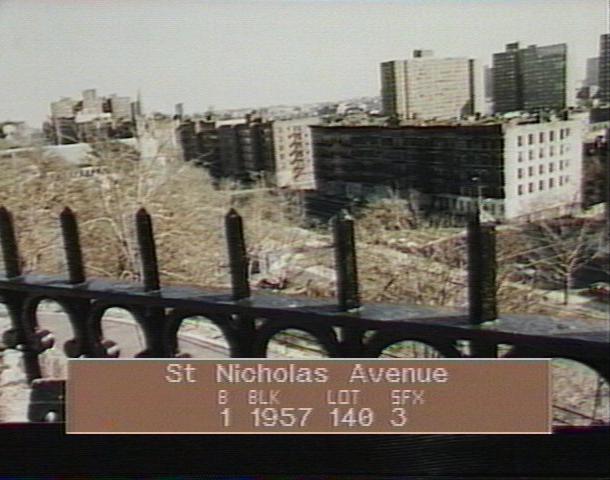
The city photographed every building for its tax records around 1940 and again in the 1980s. NYC Municipal Archives.
Written with AI from the source each entry cites, then fact-checked.
- 1800
Hamilton buys 15 acres in upper Manhattan for $4,000 to build the Grange
On August 2, 1800, Alexander Hamilton paid druggist Jacob Schieffelin $4,000 for a 15-acre plot east of the Bloomingdale Road. He had wanted the land on the west side of the road, but Schieffelin would sell only the eastern parcel. That September Hamilton added three acres to the north from Samuel Bradhurst, and a further purchase in January 1803 brought the estate to 32 acres.
“Hamilton bought the eastern site on August 2, 1800, paying $4,000 for a plot of 15 acres.”
Source: Wikipedia
- 1802
Alexander Hamilton completes his country house, the Grange
Alexander Hamilton hired architect John McComb Jr. to design a Federal-style house on a 32-acre estate in upper Manhattan, finished in 1802 and named for his father's ancestral home in Scotland. He lived here only two years before Aaron Burr fatally wounded him in their duel in July 1804. His widow, Elizabeth Schuyler Hamilton, kept using the house for 30 years after his death.
Source: National Park Service
- 1805
Archibald Gracie buys the Grange at auction after Hamilton's death
Hamilton died in July 1804 with his estate heavily in debt, much of it tied to the cost of the Grange. In 1805 Archibald Gracie bought the house at auction for $30,000 and set up a trust to run the estate. Eliza Hamilton took title on July 6, 1805, but about $55,000 was still owed, and it was repaid only after more land was sold. The last debts on the house were cleared in 1808.
“Archibald Gracie bought the house at auction in 1805 for $30,000 and set up a trust to take over the estate.”
Source: Wikipedia
- 1889
St. Luke's Episcopal Church moves the Grange to Convent Avenue
As Manhattan's street grid closed in on the old Hamilton estate, movers rolled the frame house two blocks to a new foundation at 287 Convent Avenue starting in December 1888. St. Luke's Episcopal Church, which had bought the property, finished renovating the relocated house by June 1889 and used it as a chapel and rectory.
Source: Wikipedia
- 1908
The state authorizes New York City to move the Grange to St. Nicholas Park, and nothing happens
On May 6, 1908, the New York State Legislature passed an act letting the city buy the Grange and relocate it onto parkland that was once part of Hamilton's farm. The plan stalled. A reader wrote to The New York Times in October 1913 about a halt caused by indifference or politics, and in October 1929 the paper itself faulted city officials for their alleged indifference. The house did not reach the park until 2008.
Source: Daytonian in Manhattan
- 1933
The Grange opens to the public as a house museum
The American Scenic and Historic Preservation Society bought Hamilton's former home for $50,000 in November 1924 to save it from further alteration. After restoration work, the society opened the house to the public as a museum in 1933, the first time visitors could tour Hamilton's country retreat.
Source: Wikipedia
- 1936
A Brooklyn club gives the Grange a bronze statue of Hamilton
In June 1936 the Crescent Athletic-Hamilton Club presented the Grange with a bronze statue of Alexander Hamilton. The figure had stood in front of the club's Brooklyn Heights clubhouse since 1892. The gift placed a monument to the house's builder outside the Grange, which the American Scenic and Historic Preservation Society had opened as a museum.
Source: Daytonian in Manhattan
- 1967
The Landmarks Commission designates the Grange a city landmark
In 1967 the Landmarks Preservation Commission designated Hamilton Grange, then at 287 Convent Avenue, calling it an outstanding example of Federal architecture and one of the few country seats of its period left in New York. The report admitted that, where it stood, the house could not show either its architect's conception or its look in Hamilton's day. It added that the National Park Service was weighing new sites within a block or two.
“Hamilton Grange is an outstanding example of Federal architecture, one of the few country seats of the period remaining in New York…”
- 1993
Neighbors split over the National Park Service plan to move the Grange
In early 1993 the National Park Service proposed moving Hamilton Grange and held five panel discussions about it that year. Opponents said a move would disrupt the community; one group gathered 1,200 signatures on a petition and another demonstrated outside the house. Supporters, including Manhattan Community Board 9, argued that moving it would allow a proper restoration and draw visitors, and the board voted in March 1994 to let the plan go forward.
“…one group of opponents collected 1,200 signatures for a petition against the plan, while another group demonstrated outside the house…”
Source: Wikipedia
- 2008
The Grange is lifted and rolled to St. Nicholas Park
St. Luke's Episcopal Church had moved the house to Convent Avenue in 1888 and 1889, where it stood on church property for more than a century. On June 7, 2008, workers raised it about 35 feet and rolled it half a block down Convent Avenue and a block east on 141st Street to St. Nicholas Park, a six-hour trip of about 500 feet. After a $14.5 million restoration it reopened on September 17, 2011.
Source: Wikipedia
- 2011
The relocated Grange reopens after a $14.5 million restoration
Following its 2008 move to St. Nicholas Park, the National Park Service spent three years and $14.5 million restoring Hamilton's house to its early appearance and reopened it to the public on September 17, 2011. Visitation later surged after the 2015 debut of the Broadway musical Hamilton drew new attention to the site.
Source: Wikipedia
- 2017
Visitors to the Grange hit a record after the musical Hamilton
After the Broadway musical Hamilton opened in 2015, many people who saw it went on to visit the Grange. About 35,000 people came through in 2015, and the first five months of 2016 alone brought another 35,000. The total reached a record 85,603 in 2017, compared with about 21,000 a year in 2014.
“The house saw 35,000 visitors in 2015 and another 35,000 in the first five months of 2016, with a record 85,603 in 2017.”
Source: Wikipedia
- 2020
The Landmarks Commission moves the Grange's landmark site to its new address
On June 30, 2020, the Landmarks Preservation Commission amended the Grange's designation so that the landmark site became the land beneath the house at 414 West 141st Street. It found that the old site at 287 Convent Avenue no longer held the building and had lost its special character. The change came twelve years after the house was moved and nine years after the National Park Service reopened it to visitors.
Further reading
- Hamilton Grange National MemorialWikipedia
Nearby
- St. Luke's Episcopal Church435 West 141st Street | 5 entries
- Ivey Delph Apartments19 Hamilton Terrace | 2 entries
- Harlem School of the Arts645 St Nicholas Avenue | 3 entries
- Shepard Hall, City College229 Convent Avenue | 3 entries
- Our Lady of Lourdes Church463 West 142nd Street | 4 entries
- Mount Calvary United Methodist Church116 Edgecombe Avenue | 4 entries