New York Architectural Terra Cotta Works Building
42-10 Vernon Boulevard | also 42-16 Vernon Boulevard | Long Island City | built 1892
Open on the map3 entries

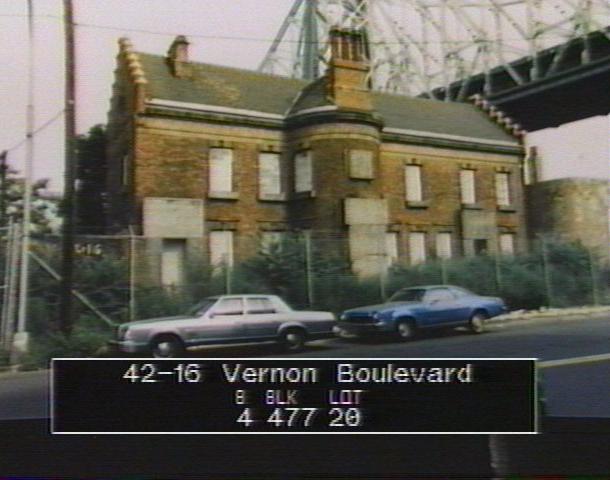
The city photographed every building for its tax records around 1940 and again in the 1980s. NYC Municipal Archives.
Written with AI from the source each entry cites, then fact-checked.
- 1892
The terra cotta company builds a showpiece office as a catalogue of its wares
Six years after Orlando B. Potter and Walter Geer founded the company, it needed offices apart from its factory and put up this two-story brick headquarters at the eastern end of its nearly two-acre riverfront site. The Renaissance and Tudor Revival front is trimmed with its own beige terra cotta: a Vitruvian scroll belt course, carved door pilasters, a plaque reading Anno Domini 1892, and chimney pots matching page 49 of its 1894 catalogue. The architect is uncertain, possibly Clarence B. Cutler.
“…bearing "Anno Domini 1892" ... chimney flues have Tudor Revival chimney pots, identical to those featured in the company's catalogue offerings.”
- 1968
Richard Dalton dies after decades running his businesses from the old headquarters
Dalton was president of the terra cotta company from 1919 until it went bankrupt in 1928-29, then started the Eastern Terra Cotta Company in 1931, which made terra cotta for Robert Moses's recreation projects in the 1930s. After that business closed in the mid-1940s he kept his construction company's offices in this building until his death in 1968. His family then sold the property to Citibank, and the factory buildings were torn down in 1976.
“Mr. Dalton used the headquarters building for his own construction company's offices until his death in 1968. In 1968, the Dalton family sold the building and property to Citibank.”
- 1982
The city landmarks the only known surviving terra cotta company office in America
The Landmarks Preservation Commission designated the building as the only building of its kind known to remain anywhere in the country and a relic of the city's only major architectural terra cotta maker. Its report noted that the original office layout survives inside, along with a first-floor overmantel, the only known signed work of James Taylor, the company superintendent often called the father of American architectural terra cotta.
“This overmantel, which is the only known, signed work of James Taylor, is among several interior features of interest in the building.”
Nearby
- Elevator Historical Society21-03 44th Avenue | 1 entry
- Silvercup Studios42-25 21st Street | 3 entries
- Blackwell House500 Main Street | 8 entries
- Strecker Memorial Laboratory10 entries
- Chapel of the Good Shepherd543 Main Street | 4 entries
- Schwarzman Animal Medical Center510 East 62nd Street | 7 entries