Public Theater
425 Lafayette Street | also 423 Lafayette Street | NoHo | built 1853
Open on the map11 entries

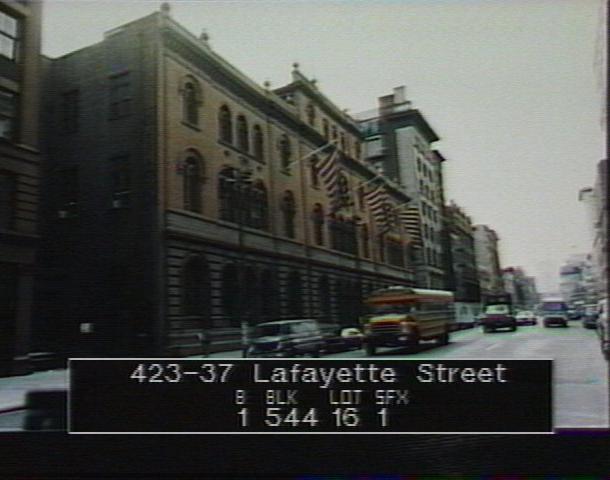
The city photographed every building for its tax records around 1940 and again in the 1980s. NYC Municipal Archives.
Written with AI from the source each entry cites, then fact-checked.
- 1854
The Astor Library opens its books to readers
John Jacob Astor's bequest paid for the library, and Alexander Saeltzer designed the building on Lafayette Place. Construction began in 1850 and ended in July 1853, but the doors stayed closed for months so the masonry could dry. Visitors could look around starting January 9, 1854, and readers could use the books from February 1. It was a reference library, so books could not be taken out.
Source: Wikipedia
- 1881
Thomas Stent's north annex opens, completing the Astor Library's three pavilions
John Jacob Astor III gave the land next door in 1879, and work on a northern annex began by March 1880. Thomas Stent designed it, plus a fourth story above the central section, in the manner of Alexander Saeltzer's original south hall. The library shut for four months in mid-1881 to finish the job, and the annex opened on October 10, 1881. It was estimated to cost $200,000 and could hold 120,000 or 150,000 more volumes.
“…the annex opened on October 10, 1881. ... Thomas Stent was hired to design the northern annex, as well as a fourth story above the central (first) annex.”
Source: Wikipedia
- 1919
The Army's 77th Division leases the empty library as a 450-bed clubhouse
After the New York Public Library moved out in 1911, the building sat little used for nine years. In March 1919 the 77th Division of the U.S. Army leased it as a temporary clubhouse with 450 beds and hired Warren and Wetmore to design a permanent structure, but the division ended up on 25th Street instead. By December 1919 the old library was an Army retail store, which had to leave once the Hebrew Immigrant Aid Society bought the building.
Source: Wikipedia
- 1921
HIAS dedicates the former library as an immigrant aid center with President Harding speaking
The Hebrew Immigrant Aid Society bought the former library for $325,000 in December 1919 and remodeled it for dormitories, a school, and immigrant intake. President Warren G. Harding spoke at the dedication ceremony on June 5, 1921. HIAS used the building until 1965, and newcomers came to call it the "door of hope".
Source: Wikipedia
- 1965
Joseph Papp tours the abandoned Astor Library and admires its architecture and large spaces
In 1965 the Landmarks Preservation Commission offered the building to Papp's New York Shakespeare Festival, which was looking for a permanent venue. Papp and his associate Bernard Gersten were shown through the abandoned library by a caretaker for the Hebrew Immigrant Aid Society. Papp found it in very poor condition, but he admired the architecture and the large interior spaces.
Source: Wikipedia
- 1965
The city designates the Astor Library building a landmark
The Landmarks Preservation Commission made the former Astor Library a city landmark on October 26, 1965, over the objection of the Hebrew Immigrant Aid Society, which was trying to sell it. A developer had planned to replace the building with apartments. In January 1966 the New York Shakespeare Festival announced it would buy the building instead.
Source: Wikipedia
- 1967
The Anspacher Theater opens at the Public Theater with a performance of Hair
Joseph Papp's New York Shakespeare Festival turned the former library into the Public Theater, with Giorgio Cavaglieri leading the renovation, and dedicated it on October 10, 1967. The Anspacher Theater, created from the library's Middle Hall, opened on October 30 with a performance of Hair. The Newman Theater followed in 1970.
Source: Wikipedia
- 1970
Anthology Film Archives builds the first Invisible Cinema in the Public Theater building
In December 1970, Anthology Film Archives opened the first Invisible Cinema, built to Peter Kubelka's design, at 425 Lafayette Street, and it stayed there until 1974. Kubelka's manifesto called for black rugs, seats, walls and ceiling, hoods on the seats and raised rows to protect the view of the screen, and blinders against distractions from the side.
Source: filmmuseum.at
- 1975
A Chorus Line premieres in the Newman Theater
A Chorus Line first played at the Public Theater's Newman Theater on April 16, 1975. Marking the 40th anniversary in 2015, artistic director Oskar Eustis credited the show with transforming how American musicals were made. The Public invited back 15 of the original cast, among them Kelly Bishop, Baayork Lee and Carole Schweid, and planned a plaque from the Hamilton cast for the lobby.
Source: theatermania.com
- 1992
The theater is renamed the Joseph Papp Public Theater
Joseph Papp, the leader of the New York Shakespeare Festival that ran the building, died in 1991. In April 1992 the building was officially renamed the Joseph Papp Public Theater to carry his name.
Source: Wikipedia
- 2015
Hamilton begins previews at the Public Theater and sells out its run
Lin-Manuel Miranda's Hamilton had its world premiere Off-Broadway at the Public Theater, directed by Thomas Kail with choreography by Andy Blankenbuehler, under the supervision of artistic director Oskar Eustis. Previews began January 20, 2015, and the show officially opened February 17. The run was extended first to April 5 and later to May 3, and the production was sold out.
“…with previews starting on January 20, 2015, and officially opening on February 17. ... The production was extended twice, first to April 5 and then to May 3.”
Source: Wikipedia
Further reading
- Astor Library BuildingWikipedia
Nearby
- 52 Cooper Square1 entry
- 54 Cooper Square2 entries
- Grace Church High School46 Cooper Square | 4 entries
- Carl Fischer Building56 Cooper Square | 4 entries
- 44 Cooper Square1 entry
- 439 Lafayette Street2 entries