A. J. Dittenhofer Warehouse
427 Broadway | also 45 Howard Street | SoHo | built 1871
Open on the map6 entries

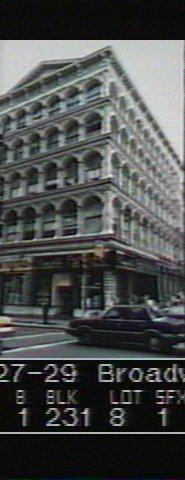
The city photographed every building for its tax records around 1940 and again in the 1980s. NYC Municipal Archives.
Written with AI from the source each entry cites, then fact-checked.
- 1854
Proprietor George W. Harpel advertises the "enlarged and refitted" City Hotel at 427-429 Broadway
Before the cast-iron store, this corner held the City Hotel. In 1854 its proprietor, George W. Harpel, advertised it as only minutes away on foot from three railroad depots, the Harlem, Hudson River and New Haven lines, with meals served at all hours. By the end of the Civil War it had been renamed the Tontine Hotel, and it was torn down in 1870.
Source: Daytonian in Manhattan
- 1870
Judge Abram J. Dittenhoefer tears down the hotel and has a cast-iron store built in six months
In 1870 Abram J. Dittenhoefer, a prominent lawyer and judge, had the old hotel demolished and hired Thomas R. Jackson, a former head draftsman for Richard Upjohn, to design a modern store and loft building. Work began on July 1, 1870, and cast iron let it finish on January 12, 1871. Jackson dressed the corner in French Renaissance ornament, with Corinthian columns and rows of round arches.
Source: Daytonian in Manhattan
- 1873
Fur merchants Peake, Opdycke & Co., the first tenant, fail just two years after moving in
The building's first occupant was Peake, Opdycke & Co., which sold furs from buffalo, beaver, mink and sable through dry-goods dealers across the country. On October 9, 1873 The Nation reported that the firm had failed. The magazine blamed the savings banks for hoarding greenbacks and said collecting payments had become too difficult for a business of that size.
Source: Daytonian in Manhattan
- 1887
Women at the men's furnishings factory walk out after a wage cut of about 50 percent
The Davies firm, a maker of men's furnishings, ran a factory here. In 1887 its superintendent, Schautz, told the women workers they must accept $3 or $4 a week, and they answered that no respectable girl could live on that. After he seemed to relent, a cut averaging 50 percent arrived, and the whole female workforce walked out. The Times reported on July 21 that the factory was nearly shut down.
Source: Daytonian in Manhattan
- 1888
A cashier forges a payroll check and is tracked to Montreal through his new wife
Albert E. Krahl, cashier of the button dealers S. Hirsch & Co., changed a $900 payroll check to $3,900, cashed it, paid the workers and vanished. Detectives learned he had married five months earlier and followed his wife, which led them to him in Montreal. The Evening World reported his arrest on June 29, 1888, and he was extradited to face a forgery charge.
Source: Daytonian in Manhattan
- 1991
The Nancy Hoffman Gallery opens here as SoHo becomes Manhattan's art center
As SoHo's old warehouses filled with artists and galleries in the late twentieth century, the Nancy Hoffman Gallery was already open in the building by 1991. In the 2000s the performance space Hub, an offshoot of the Performa festival, also operated here. The 1871 structure has survived with unusual completeness, including its ground floor, which is normally the first part of such buildings to be altered.
Source: Daytonian in Manhattan
Further reading
- A. J. Dittenhofer WarehouseWikipedia
Nearby
- 425 Broadway2 entries
- Benjamin Lord House423 Broadway | 5 entries
- 305 Canal Street1 entry
- Arnold Constable & Co. store, 307 Canal Street307 Canal Street | 3 entries
- 303 Canal Street2 entries
- 299 Canal Street1 entry