Art Projects International
434 Greenwich Street | also 49 Vestry Street | Tribeca | built 1884
Open on the map4 entries

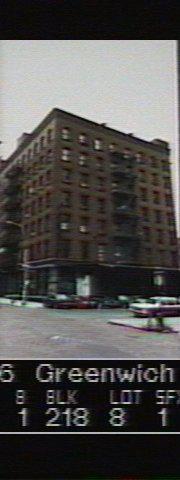
The city photographed every building for its tax records around 1940 and again in the 1980s. NYC Municipal Archives.
Written with AI from the source each entry cites, then fact-checked.
- 1883
Older masonry and wood buildings, including a lard refinery, are cleared from the Greenwich Street block
Before the current warehouse went up, this stretch of Greenwich Street held a mix of older masonry and wood buildings. The city's landmark report names one of them, a lard refinery run by William J. Wilcox & Company, on the northern half of the block. All of it was cleared when soap maker James Pyle began building here in 1883. This entry describes earlier buildings on the site.
- 1883
James Pyle moves his Pearline soap headquarters into a new seven-story Greenwich Street factory
Soap manufacturer James Pyle had Thomas R. Jackson design this building in 1883 as a factory and workshop, the first of five Jackson designed for him on the block. Pyle moved the headquarters of his Pearline soap business here from Washington Street. By the time Pyle died in 1912, his main soap plant had been shifted to Shady Side on the Hudson River.
- 1883
Thomas R. Jackson gives Pyle's warehouse red brick, rock-faced granite and Duclos cast-iron piers
The seven-story building has a 99-foot front on Greenwich Street and 79 feet on Vestry Street. Jackson kept the red brick design plain, adding Romanesque Revival touches: rough granite over the arched windows, plus a cornice of corbelled brick and granite. At street level, the cast-iron piers bear plates from the J.M. Duclos & Co. Iron Works foundry, and a brick wall divides the building into northern and southern halves.
“…designed in 1883 by Thomas R. Jackson ... for James Pyle, a soap manufacturer. The design of the red brick facades is fairly utilitarian, enriched with Romanesque Revival detailing…”
- 1911
Grocery wholesalers Birdsong Brothers and then Meyer & Lange take over the old soap factory
In 1911 the wholesale grocery firm Birdsong Brothers leased the southern half of the building, along with 428 Greenwich Street. Another wholesale grocer, Meyer & Lange, occupied the building from the 1910s into the 1940s. Later it served as a facility of the Port Warehouses operation, whose signs are still visible on the facade.
Further reading
- Art Projects InternationalWikipedia
Nearby
- James Pyle building430 Greenwich Street | 3 entries
- 415 Washington Street2 entries
- 428 Greenwich Street2 entries
- 426 Greenwich Street2 entries
- 440 Greenwich Street1 entry
- 70 Laight Street2 entries