Colonnade Row
434 Lafayette Street | NoHo | built 1833
Open on the map7 entries

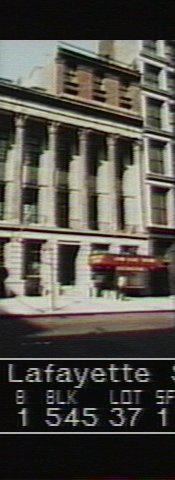
The city photographed every building for its tax records around 1940 and again in the 1980s. NYC Municipal Archives.
Written with AI from the source each entry cites, then fact-checked.
- 1833
La Grange Terrace, a row of nine marble houses, is completed on Lafayette Place
The nine Greek Revival houses, later known as Colonnade Row, are believed to have been built by contractor Seth Geer on land John Jacob Astor bought in 1804. Architects Ithiel Town and James Dakin are thought to have started work in the winter of 1831-32, and the Landmarks Preservation Commission dates completion to 1833. Designers named for the row include Alexander Jackson Davis, though some doubt he took part. Residents included Washington Irving and Cornelius Vanderbilt.
Source: Wikipedia
- 1902
A 1902 plan to move the surviving row to Bryant Park fails
By 1860 Murray Hill had become the more fashionable address, and the area around Lafayette Place declined. More than half of the nine houses were torn down to clear space for Wanamaker's department store and warehouse. A 1902 proposal to move the rest to Bryant Park failed, and the five houses at 418 through 426 Lafayette Place were demolished, leaving the four at 428 through 434 Lafayette Street.
Source: Wikipedia
- 1965
The city landmarks the four surviving houses among its first designations
The four remaining houses, at 428 through 434 Lafayette Street, were designated New York City landmarks on October 14, 1965, among the first buildings the city protected. They had been divided into apartments and commercial space and were in poor condition by then. The National Register of Historic Places listed them in December 1976.
Source: Wikipedia
- 1968
The Astor Place Theatre opens with Al Pacino in The Indian Wants the Bronx
Bruce Mailman had bought the building in 1965. The theater's first production, on January 17, 1968, was Israel Horovitz's The Indian Wants the Bronx, with newcomer Al Pacino in the lead. It built a reputation for new and often experimental playwrights such as Tom Eyen, and Terrence McNally, A.R. Gurney and Larry Shue also premiered plays there. The revue Jacques Brel is Alive and Well and Living in Paris had a successful run in 1974.
“Bruce Mailman bought the building in 1965. On January 17, 1968, the theater opened with Israel Horovitz's The Indian Wants the Bronx starring newcomer Al Pacino.”
Source: Wikipedia
- 1976
The surviving houses are added to the National Register of Historic Places as LaGrange Terrace
The four surviving houses, numbers 428, 430, 432 and 434 Lafayette Street, were nominated for the National Register in August 1976. They were listed that December under the name LaGrange Terrace.
“The buildings were added to the National Register of Historic Places in December 1976 after being nominated in August of the same year.”
Source: Wikipedia
- 1991
Blue Man Group makes the Astor Place Theatre its home and buys it in 2001
Blue Man Group began performing at the theater in 1991. It bought the theater in 2001 and kept its show running there until February 2, 2025.
Source: Wikipedia
- 2025
No Guarantees Productions takes over the Astor Place Theatre
In May 2025 the company No Guarantees Productions, run by Christine Schwarzman, took a lease on the theater. It planned to present dramas there.
Source: Wikipedia
Further reading
- Colonnade RowWikipedia
Nearby
- Colonnade Row (430 Lafayette Street)430 Lafayette Street | 6 entries
- 436 Lafayette Street4 entries
- Colonnade Row (La Grange Terrace)432 Lafayette Street | 4 entries
- Colonnade Row (428 Lafayette Street)428 Lafayette Street | 5 entries
- 736 Broadway3 entries
- Treffurth's732 Broadway | 4 entries