Bronx Opera House
436 East 149th Street | also 438 East 149th Street | Mott Haven | built 1912
Open on the map12 entries

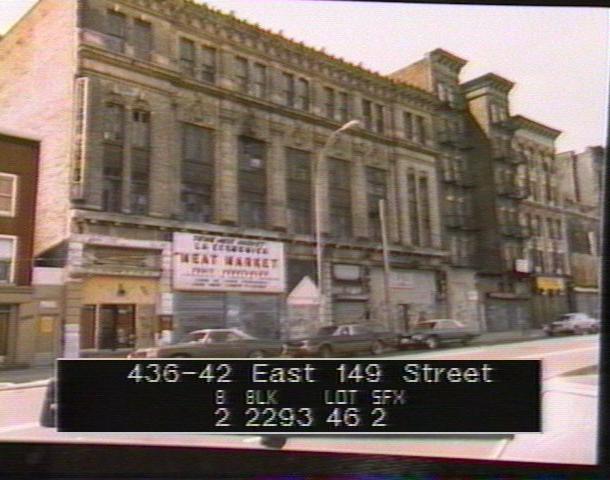
The city photographed every building for its tax records around 1940 and again in the 1980s. NYC Municipal Archives.
Written with AI from the source each entry cites, then fact-checked.
- 1912
Cohan and Harris lease a stable site on East 149th Street for a Bronx theater
In early May 1912 Sam H. Harris told Variety that he and George M. Cohan had secured land on East 149th Street, a short way east of Third Avenue, for a Bronx sister to their Grand Opera House in Manhattan. The project went public that June, with George M. Keister as architect and a lease taken from Frederick Schnaufer, whose stable occupied the land. Cramp & Co. won the $250,000 construction contract that September.
Source: Wikipedia
- 1913
The Bronx Opera House opens with Fine Feathers as crowds jam East 149th Street
The theater was dedicated on the night of August 30, 1913, with Eugene Walter's play Fine Feathers, a Harry Frazee production. Cohan, Harris, A. H. Woods and Frazee were all in the audience, joined by members of the Friars' Club, and Max Figman, of the cast, gave an address presenting the theater on behalf of the management, which Assemblyman Louis D. Gibbs accepted for the people of the Bronx. The throng outside grew so large that police were called to clear the sidewalk and street, and the cast answered six curtain calls.
“Outside, the crowd gathering was such that the police was called to clear the sidewalk and the street.”
Source: Wikipedia
- 1916
Beppo, a donkey from Pagliacci, vanishes from outside the theater along with a red car
During the Aborn Opera Company's six-week run, the keeper of Beppo, a donkey who appeared on stage in Pagliacci, tied him to a car parked in front of the theater on June 7. Cavalleria Rusticana followed Pagliacci on the bill, and the keeper slipped back inside to hear an aria or two. When he came out, both the red car and Beppo, a stage veteran of ten years, were gone.
“When the keeper came out, the red car was gone and so was Beppo the donkey, a ten-year veteran of the stage.”
Source: Wikipedia
- 1917
John and Lionel Barrymore star together in Peter Ibbetson at the Bronx Opera House
On November 19, 1917, the brothers John and Lionel Barrymore appeared here in John Raphael's play Peter Ibbetson. John had played the house before: a week in Willard Mack's Kick-In in April 1915, and John Galsworthy's Justice in September 1916.
“John and Lionel Barrymore are on stage November 19 in John Raphael's play Peter Ibbetson.”
Source: Wikipedia
- 1941
The Friendship Club begins its old-time dances for over-28s, with no jitterbugs allowed
From 1941 to 1954 the Friendship Club held many events in the building, most likely in the banquet hall of its front section. Organizer Lester Lockwood described it as a small-town social for old-fashioned dancing aimed at the middle-aged and older, and its advertisements warned 'Folks over 28 only, no jitterbugs.' By the mid-1950s the space had become the Tara Ballroom, an Irish dance hall, just as the area's Irish American population was shrinking.
- 1959
Gil and Sonny Merced and Federico Pagani open La Caravana in the old banquet hall
In April 1959 the brothers Gil and Sonny Merced and promoter Federico Pagani, known as El Gran Federico, opened La Caravana, also called the Club Caravana, in the former banquet hall of the Bronx Opera House. Advertised as a roomy ballroom-cabaret, it was the first of three prominent Latin music clubs to occupy the space over the next two decades, followed by the Bronx Casino and El Cerromar.
- 1960
Johnny Pacheco gets his first album after Al Santiago hears him at La Caravana
At Federico Pagani's invitation, Albert Santiago of Alegre Records came to La Caravana to hear bandleader Johnny Pacheco, and Alegre produced Pacheco's first album in 1960. His group, Pacheco y su Charanga, quickly rose to the front rank of that era's charanga bands. By October of that year Pacheco, Charlie Palmieri and others were playing the new pachanga at the club while its patrons took up the dance.
“Johnny Pacheco, whose first album was produced by Alegre Records in 1960, after Albert Santiago visited La Caravana on Federico Pagani's invitation…”
- 1961
Charlie Palmieri records a live pachanga album inside the Caravana Club
In 1961 pianist Charlie Palmieri and his orchestra, Charanga La Duboney, recorded the album Pachanga La Caravana live in the club; its back cover likened the Caravana to an off-Broadway show for the nightclub trade. The record cemented the club's name as the Home of Pachanga. The same year, patrons formed Los Pachengueros, six dancers sponsored by the club, who demonstrated new pachanga steps and sold out shows at other clubs in the Bronx and on Long Island.
“Charlie Palmieri and his orchestra “Charanga La Duboney” recorded their album Pachanga La Caravana live in the club.”
- 1963
La Caravana reopens as the Bronx Casino, a stage for Tito Puente, Machito and the Palmieris
After La Caravana closed in 1962, businessmen Raul Quintana and Angel Maceda reopened the room in 1963 as the Bronx Casino, with Eduardo Davidson, billed as the King of Pachanga, on the opening-night program. Charlie and Eddie Palmieri, Joe Quijano, Johnny Pacheco and Ray Barretto played there regularly, alongside Tito Rodriguez, Machito and Tito Puente. The club also lent its name to a record, Johnny 'El Bravo' Lopez and His Super Combo at the Bronx Casino.
“La Caravana closed in 1962 and re-opened as the Bronx Casino in 1963 under the management of businessman Raul Quintana and Angel Maceda…”
- 1978
The Landmarks Commission weighs protecting the theater, then votes against it
In 1978-79 the Landmarks Preservation Commission considered making the Bronx Opera House and its auditorium interior landmarks. The owner had defaulted, the mortgagor objected, and the commission declined to designate. Advocates organized as the South Bronx Cultural Center Fund persuaded the city housing department to seal the building, and Mayor Edward Koch backed fund-raising to turn it into a cultural center and public library. The city took the building for taxes in 1981 and auctioned it in 1983.
“The building's owner had defaulted, and the mortgagor opposed designation. The Commission voted not to designate the building at that time.”
- 2013
The front building reopens as the Opera House Hotel after the auditorium is torn down
From 1984 to 2008 the building housed a Pentecostal church, Templo de Renovacion Espiritual, before a hotel plan was approved in 2008. Between 2009 and 2011 the rear building holding the old auditorium was demolished and replaced with a three-story office building. The front building became the Opera House Hotel in 2012-2013; its owner, prompted by 1912 playbills and posters found on site, cleaned the facade, recreated lost details and fitted new windows and lighting.
“…the property owner was inspired by a discovery of 1912 playbills and posters and other historical documentation on site…”
- 2023
The Bronx Opera House is designated a landmark, Cohan and Harris's initials still on its facade
The Landmarks Preservation Commission designated the surviving front building on June 13, 2023. George Keister's Italian Renaissance Revival facade has seven bays in three tiers, clad in buff brick with terra-cotta ornament, above a base divided by rusticated limestone pillars. Cartouches over the middle third-story windows bear an interlaced C & H, probably for Cohan and Harris, and rings that once held the theater marquee survive on two cartouches at the west end.
Further reading
- Opera House HotelWikipedia
Nearby
- 441 East 148th Street3 entries
- Hertlein and Schlatter Silk Trimmings Factory454 East 148th Street | 3 entries
- C. Rieger's Sons Factory452 East 148th Street | 2 entries
- Haffen Building2804 3rd Avenue | 6 entries
- Dollar Savings Bank2792 3rd Avenue | 6 entries
- Public School 27 (St. Mary's Park School)519 St Anns Avenue | 3 entries