Seguine Mansion
440 Seguine Avenue | also 178 Trenton Court | Prince's Bay | built 1899
Open on the map7 entries

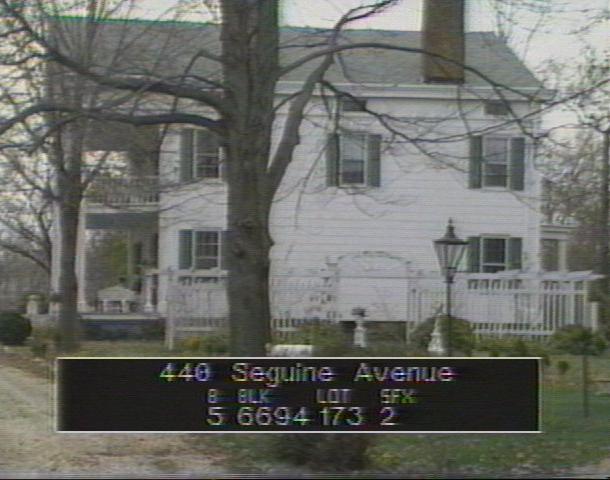
The city photographed every building for its tax records around 1940 and again in the 1980s. NYC Municipal Archives.
Written with AI from the source each entry cites, then fact-checked.
- 1840
Joseph H. Seguine builds a Greek Revival mansion above the lower bay
Joseph H. Seguine put up this house around 1840 on rising ground overlooking New York's lower bay, on an estate that once ran from Princess Bay to the rail line. Six paneled columns two stories tall hold up its low pedimented gable, and white clapboards cover the original stone walls of the eighteen-room house. The Landmarks Preservation Commission later likened it to an ante-bellum mansion of the Deep South.
- 1848
Mansion owner Joseph Seguine opens a candle factory on his shore lands
Joseph H. Seguine, born in 1801, made money in the Prince's Bay oyster trade and ran one of Staten Island's largest farms. In 1848 he founded the Staten Oil and Candle Company on part of his property, where more than a hundred workers made candles from palm oil shipped from Africa. That same year his neighbor Frederick Law Olmsted wrote about Seguine's fleet of oyster schooners.
“In 1848 he established the Staten Oil and Candle Company on the portion of his lands…”
- 1874
An 1874 atlas labels the Seguine mansion the Prince's Bay House
An 1874 atlas of Staten Island labeled Joseph Seguine's Greek Revival house the "Prince's Bay House," which suggests to the Landmarks Preservation Commission that it had been turned into a hotel. A later atlas, from 1907, placed a Bayview Hotel a short way north of the mansion and another hotel by the shore.
- 1916
Seguine descendants buy back the family mansion
The Seguine family had been forced to sell the house and its land in 1868. In 1916 descendants managed to buy the house back, and it stayed with the family for another 65 years, until 1981.
“In 1916, descendants were able to repurchase the house and it remained in the family until 1981.”
Source: Wikipedia
- 1967
The city designates the Seguine House a landmark
The Landmarks Preservation Commission designated the Seguine House at 440 Seguine Avenue a landmark on May 25, 1967. Nobody spoke at its September 1966 hearing, and the owners told the commission they supported designation. The commission's report noted that the eighteen-room house had come through fire, time and creeping urbanization.
- 1981
George Burke buys the run-down mansion and restores it
In 1981 the house, badly in need of repair, went to George Burke, who had already restored other old buildings nearby and kept the property from being subdivided. Restoring the outside alone took over five years and used sixty gallons of paint. He then furnished the rooms with art and furniture he had collected in England after World War II while serving in the Air Force.
“The renovation of the outside of the house took more than five years and sixty gallons of paint.”
Source: Wikipedia
- 1989
George Burke donates the Seguine Mansion to New York City
After restoring the house and setting up an equestrian center on the grounds, George Burke donated the house to New York City in 1989, keeping a life interest in it. The Parks Department owns the house, and the Friends of the Seguine Mansion give tours by appointment.
“Burke donated the Seguine Mansion to the City of New York in 1989, and retains a life interest in the site.”
Source: Wikipedia
Further reading
- Seguine MansionWikipedia
Nearby
- Manee-Seguine Homestead509 Seguine Avenue | 6 entries
- John H. and Elizabeth J. Elsworth House90 Bayview Avenue | 4 entries
- Abraham J. Wood House5910 Amboy Road | 3 entries