Meriden Britannia Co. Building
45 Beekman Street | Financial District | built 1900
Open on the map7 entries

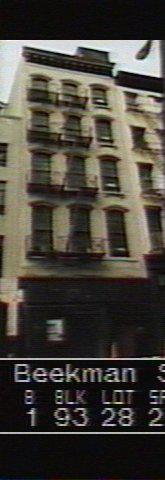
The city photographed every building for its tax records around 1940 and again in the 1980s. NYC Municipal Archives.
Written with AI from the source each entry cites, then fact-checked.
- 1831
Blind-maker Benjamin Hallsted lives in an earlier house here and works from a shop in the rear yard
Before the present building, the lot held a comfortable house where the family of Benjamin Hallsted lived by 1831; he ran a blind-making shop in a small building in the rear yard. By the mid-1840s Hallsted had relocated his household to Sixth Avenue, and the house became a boarding house. In 1853 the widow Jane E. Bromley leased it, advertising rooms and board to single gentlemen and couples, and her boarders included bookseller Patrick Daly and City Hall policeman Patrick McGrath.
Source: Daytonian in Manhattan
- 1857
Hallsted razes his house and shop and builds a five-story loft faced in white marble
In 1857 Benjamin Hallsted tore down the two buildings on his property, the house and the rear shop, and put up a new loft-and-store building, 23 feet wide and five stories tall, with a white-marble front above the storefront. Its Italianate details, such as molded lintels over segmentally arched openings, would have suited an up-to-date house as well as a commercial building.
Source: Daytonian in Manhattan
- 1858
The Meriden Britannia Co., maker of silver-look tableware, becomes the building's main tenant
The new building's main tenants were the Meriden Britannia Co. and its related Meriden Cutlery Co., a Connecticut firm founded five years earlier. Its tea sets, coffee services and flatware were made from Britannia metal, a pewter alloy polished to resemble fine silver, and its elaborate Victorian designs sold for less than sterling. H. H. Beadle Cutlery and Henry Jeroliman's stationery store were also early tenants; the Meriden company moved out in 1870.
Source: Daytonian in Manhattan
- 1874
A porter falls from the fifth floor to the first through the building's open hatchway and breaks both legs
Before freight elevators were common, firms in the building hoisted goods through a hatch, a shaftway fitted with pulleys and ropes, but open hatchways were hazardous and led to repeated accidents. In September 1874 The Evening Telegram reported that Henry James, a porter from Brooklyn, had fallen through the hatchway of 45 Beekman Street from the fifth floor to the first and broken both of his legs. The building's tenants then included a saddlery-hardware dealer, a bookstore and a printer.
Source: Daytonian in Manhattan
- 1900
Paper wholesaler Myrick Plummer, who bought the building from his landlord, dies after a second stroke
Around 1894 tenant Myrick Plummer, head of the wholesale paper firm M. Plummer & Co., bought 45 Beekman Street from James C. Hallsted. A native of Maine in the paper business since 1865, he lived in a mansion at 18 East 68th Street. A stroke in March 1900 forced him to retire, and a second, more severe one killed him on May 17; the New-York Tribune described him as a prominent wholesale paper merchant, and his widow, Mary Emma, became the owner.
Source: Daytonian in Manhattan
- 1905
Stephen Caplin's Union Card & Paper Co. buys the building and becomes its sole occupant for decades
In February 1905, after the building had changed hands three times following Mary Plummer's 1904 sale, Stephen Caplin, head of the Union Card & Paper Co., bought it. Unlike the earlier paper and printing firms that shared the floors, Union Card & Paper would be its only occupant for decades. Each year it sent customers a complimentary pocket calendar, and its diary for 1913 came in red leather with gold lettering.
Source: Daytonian in Manhattan
- 1976
A 1976 renovation turns the old marble loft's upper floors into apartments
In 1976 the marble building was renovated so that each floor above the shop became a single apartment. An update completed in 2002 doubled that to two apartments per floor. The marble has since been painted white, and the storefront has been given a modern but sympathetic remake.
Source: Daytonian in Manhattan
Further reading
- The 1858 Meriden Britannia Co. Bldg - 45 Beekman StreetDaytonian in Manhattan
Nearby
- Engine 6 firehouse (former Engine Co. 32)49 Beekman Street | 6 entries
- NewYork-Presbyterian Lower Manhattan Hospital40 Beekman Street | 6 entries
- 8 Spruce Street6 entries
- 130 William130 William Street | 8 entries
- One Pace Plaza1 Pace Plaza | 12 entries
- Morse Building140 Nassau Street | 4 entries