Whittemore House
45 Grove Street | also 43 Grove Street | West Village | built 1830
Open on the map6 entries

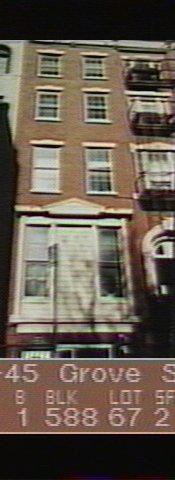
The city photographed every building for its tax records around 1940 and again in the 1980s. NYC Municipal Archives.
Written with AI from the source each entry cites, then fact-checked.
- 1830
Textile machinery maker Samuel Whittemore builds a 47-foot-wide Federal mansion on grounds reaching Christopher Street
Samuel Whittemore, head of S. Whittemore & Company, which made steam-driven carding machines for textile mills, built the house in 1830. It was originally two stories and set back from the street, with a porch at the rear. The grounds ran through to Christopher Street on the north and Bleecker Street on the east, and had a cistern, well, hot house and stables. His family owned much of the blocks around it.
“Samuel Whittemore was the senior member of the firm of S. Whittemore & Company, manufacturer of steam-propelled carding equipment used in the textile industry…”
- 1865
John Wilkes Booth calls on a boarder, actor Samuel K. Chester, to enlist him in a plot to kidnap Lincoln
By 1865 the house was a high-end boarding house, and the actor Samuel K. Chester lived in it. Daytonian in Manhattan recounts that early that year Booth knocked at his door and, in Chester's words, asked for help with a conspiracy to take over the government, including kidnapping President Lincoln. Chester refused, but told no one. Booth assassinated Lincoln that April.
Source: Daytonian in Manhattan
- 1865
Louisa Lee Schuyler turns the house into the Lincoln Home for disabled soldiers and seamen
Later in 1865, Louisa Lee Schuyler, a great-granddaughter of Alexander Hamilton who became a leader in American charity work, converted the house into the Lincoln Home, a hospital for wounded soldiers. The New York Times reported on October 8, 1865 that about sixty disabled soldiers and seamen were in its care.
Source: Daytonian in Manhattan
- 1870
Elisha Bloomer has architect B. G. Wells turn the lower floors into stores and add new windows
Elisha Bloomer, a stone merchant who bought the mansion in 1857, hired architect B. G. Wells in 1870 for the main alterations. The basement and parlor floor became stores, which moved the building from the first to the second class. Paired windows under a low pediment replaced the parlor-floor windows beside the entrance, in the Neo-Grec manner. The Italianate entrance doors probably date from the same ownership.
- 1921
A basement theater stages a marionette version of an Edna St. Vincent Millay play
By 1921 a theater operated at basement level. On February 19 the theater put on Edna St. Vincent Millay's Two Slatterns & a King as a puppet show with marionettes. The following week's bill was advertised as a showcase of American Indian art and literature, with dances and drum music.
Source: Daytonian in Manhattan
- 1923
Poet Hart Crane rents a second-floor room here while struggling to make a living
In 1923 the writer Hart Crane rented a room on the second floor of No. 45, then a multi-family house with a theater in its basement. He was struggling to earn a living at the time. The house had been a mansion for Samuel Whittemore and later a boarding house, and its upper floors were divided into apartments.
Source: Daytonian in Manhattan
Further reading
- The Whittemore House - 45 Grove StreetDaytonian in Manhattan
- Then & Now photos: 45 Grove StreetVillage Preservation: Greenwich Village Then & Now
Nearby
- 318 Bleecker Street1 entry
- 324 Bleecker Street4 entries
- 316 Bleecker Street1 entry
- Grove Street Playhouse39 Grove Street | 4 entries
- 94 Christopher Street1 entry
- 326 Bleecker Street1 entry