450 Broadway
SoHo | built 1877
Open on the map6 entries

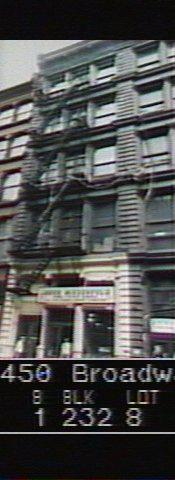
The city photographed every building for its tax records around 1940 and again in the 1980s. NYC Municipal Archives.
Written with AI from the source each entry cites, then fact-checked.
- 1840
A two-story frame house at 450 Broadway serves as W. Robert's Half Way House before the Lorillard building
A view from 1840 in the Museum of the City of New York, covering the stretch of Broadway's east side between Howard and Grand Streets, shows a two-story frame former residence at No. 450. It was then occupied by W. Robert's Half Way House. This earlier building stood on the lot before the Lorillard family had John B. Snook put up the present cast-iron store in 1876-77.
Source: Daytonian in Manhattan
- 1877
Snook's 450 Broadway is a narrower, three-bay version of its neighbor, with Corinthian columns and a curved frieze
The Lorillard family commissioned John B. Snook to design 450 Broadway and its larger sibling at 446-448, and work finished on May 25, 1877. The narrower building has Corinthian columns on pedestals at its storefront, and each of its four upper floors is marked off by a molded cornice. Snook gave the top a concave, paneled frieze that follows the curve of the brackets.
Source: Daytonian in Manhattan
- 1886
Workers at the men's neckwear firm Fleisch & Co. walk out of 450 Broadway and win shorter hours
Fleisch & Co., run by Jacob H. and Nathan Fleisch, was probably one of the first tenants at 450 Broadway. Its factory employed mostly women to make men's ties and bows. In the spring of 1886 the employees walked out, and on May 13 the New York Times reported that the firm had compromised by cutting the working day to between nine and a half and ten hours.
Source: Daytonian in Manhattan
- 1889
Umbrella maker Wright Bros. & Co. produces about a million umbrellas and parasols a year at 450 Broadway
Around 1886 the Philadelphia umbrella, cane, and parasol maker Wright Bros. & Co. took space at 450 Broadway. The firm, founded in 1816, had branches in Boston, Chicago, and New York by 1885. In 1889 the trade paper Clothier and Furnisher said it was turning out roughly one million umbrellas and parasols annually, and recalled that during the Civil War it had turned its works over to army clothing, employing more than 500 workers.
Source: Daytonian in Manhattan
- 1897
Silberstein, Hecht & Co., makers of the Griffon razor, moves into 450 Broadway
The newly formed Silberstein, Hecht & Co. took space at 450 Broadway in 1897. Albert Lyman Silberstein, who came from Prussia to America as a child in 1870, had earlier started the Griffon Cutlery Co. The new firm made and imported sterling silver pocket cutlery and safety razors, and Silberstein held the patent on the Griffon razor, filed in September 1896.
Source: Daytonian in Manhattan
- 1979
Artist Patti Paige opens Baked Ideas, a shop selling decorated cookies, in the ground floor of 450 Broadway
As SoHo shifted from industry to artists, the street-level shop at 450 Broadway changed too. In 1979 the artist Patti Paige opened Baked Ideas there, using her grandmother's cookie recipes and decorating each cookie with portraits, buildings, or cartoon characters. In February 1983 the New York Times food columnist Marian Burros wrote up its Valentine's Day heart cookies.
Source: Daytonian in Manhattan
Nearby
- 446 Broadway2 entries
- 454 Broadway1 entry
- 452 Broadway1 entry
- 456 Broadway1 entry
- 444 Broadway1 entry
- 125 Grand Street2 entries