Villard Houses and Lotte New York Palace
455 Madison Avenue | also 24 East 51st Street, 457 Madison Avenue, 30 East 51st Street | Midtown | built 1980
Open on the map19 entries

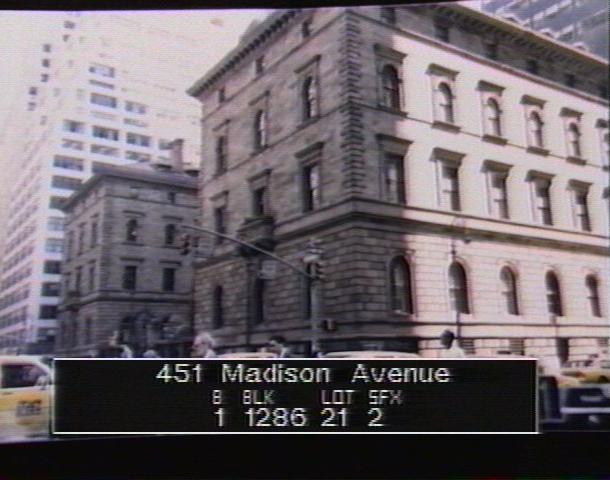
The city photographed every building for its tax records around 1940 and again in the 1980s. NYC Municipal Archives.
Written with AI from the source each entry cites, then fact-checked.
- 1882
Journalist and railroad financier Henry Villard begins a linked group of brownstone mansions on Madison Avenue
Henry Villard, born in Bavaria, came to America in 1853 and covered the Lincoln-Douglas debates and the Civil War as a reporter. In 1881 he took control of the New York Evening Post, and as a railway promoter he led the Northern Pacific until 1893. His wife Helen was the daughter of the abolitionist William Lloyd Garrison. Work on the Madison Avenue houses began in 1882 and the main group was finished in 1884.
“Henry Villard (1835-1900), who built this group of Houses and occupied one of them, was a journalist, railway promotor and financier.”
- 1883
Henry Villard moves into his new house just as bankruptcy closes in
Henry Villard moves into the lavishly designed house of his Madison Avenue complex at the end of 1883, as his railroad empire begins to collapse. He lives there only a few months. Bankruptcy sends him to Westchester, and he offers his real estate holdings to friends.
Source: 6sqft
- 1884
McKim, Mead & White finish a U-shaped Italian palace of six houses around a courtyard
Villard hired the three-year-old firm of McKim, Mead & White, which took Rome's Palazzo della Cancelleria as its model. Four of the houses opened onto the courtyard and two onto 51st Street. Augustus Saint-Gaudens carved mantels, and the interiors included parquet floors and mosaic-covered vaults. Villard's own Evening Post praised the restrained design and contrasted it with what it called the vulgar mansions a block away on Fifth Avenue.
Source: Daytonian in Manhattan
- 1886
Whitelaw and Elisabeth Reid buy Villard's house and replace its gas lighting with electric
Tribune editor Whitelaw Reid and his wife Elisabeth Mills Reid buy Villard's house in 1886. They switch it from gas lamps to electric fixtures, and it is described as the first New York residence built with Edison fittings suited to a citywide power supply rather than a private generator. A hydronic elevator, unusual in a private home, is also added.
Source: 6sqft
- 1891
Stanford White designs the Madison Room as a triple drawing room for the Reids' entertaining
In 1891 Stanford White designs the Madison Room for the Reid family as a triple drawing room where they can receive guests. He lines it with pale green marble walls and pillars, coffered ceilings, bronze moldings and stained glass, with large fireplaces at each end and murals by P.V. Galland. The room still stands inside the hotel.
Source: 6sqft
- 1909
An eight-story addition goes up at the east end of the Villard complex
In 1909 the Villard complex gained an eight-story addition at its east end, on the 50th Street side. The Landmarks Commission recorded that Whitelaw Reid was then occupying the south wing.
- 1925
Elisabeth Mills Reid still lives at 451 Madison Avenue with seventeen servants
Henry Villard lost his fortune around the time the houses were finished, and his own residence was bought by Elisabeth Mills Reid, whose husband Whitelaw Reid edited the New-York Tribune. While Fifth Avenue millionaires moved north, the Villard Houses' owners stayed. As late as 1925 Mrs. Reid lived at No. 451 with 17 servants, among them four footmen and two French cooks.
Source: Daytonian in Manhattan
- 1943
The Reid mansion becomes a Women's Military Services Club with fifty-cent beds
After Mrs. Reid's death, her home at 451 Madison was turned into the Women's Military Services Club in 1943. Mayor Fiorella La Guardia attended the dedication and remarked that such private mansions would not be seen again. Rooms cost the servicewomen 50 cents a night, and by 1945, when the war ended, over 250,000 of them had stayed there.
Source: Daytonian in Manhattan
- 1946
Random House buys the north house, and Bennett Cerf pays $450,000 for a mansion Joseph Kennedy never lived in
In 1946 the publisher Random House buys 457 Madison Avenue, along with a one-third share of the courtyard, and converts the house into offices. Bennett Cerf pays $450,000, believing that to be the price Joseph P. Kennedy had paid for it the year before. Kennedy never lived in the house, which had stayed occupied by the French Relief Societies.
Source: Wikipedia
- 1968
The Landmarks Commission designates the Villard Houses as a unified group
On September 30, 1968 the Landmarks Preservation Commission designated the Madison Avenue section of the Villard Houses. Its report said no other group of brownstone residences in the city matched them in size and called the complex an early break from the picturesque styles toward Renaissance formality. Two witnesses spoke in favor of designation at the 1966 hearing and none opposed.
“Nowhere in New York City does there exist another unified group of brownstone residences of such magnitude as this cluster standing on Madison Avenue.”
- 1974
Preservationists and critic Ada Louise Huxtable oppose Helmsley's plan to build a tower behind the houses
In early 1974 Harry Helmsley sought air rights above the houses from the Archdiocese to build a 50-story glass tower, which would have demolished parts of the center wing. At a December 1974 hearing Villard's great-grandson testified for preservation, and architecture critic Ada Louise Huxtable called the proposal death-dealing rather than life-giving. The Landmarks Commission approved a hotel in principle in January 1975, and a group named Society Against Villard's Extinction kept fighting it.
Source: Wikipedia
- 1978
The Villard rooms are taken apart piece by piece, labeled and stored while the hotel tower goes up
When work on the Helmsley Palace begins in 1978, the Villard mansion is taken apart by hand rather than gutted. Floorboards are labeled and lifted out, while carvings, railings, paintings, chandeliers, stained glass and hardware are crated and stored, and castings are made of fragile plaster ceilings. The floorboards are later repositioned precisely after repair.
Source: lottenypalace.com
- 1979
Harry Helmsley leases space in the north wing to Jacqueline Kennedy Onassis for the Urban Center
In June 1979 Harry Helmsley leased 30,000 square feet of the north wing to Jacqueline Kennedy Onassis, for the Urban Center, a shared headquarters for four civic organizations. It opened in August 1980, and its bookstore followed that October. Two months after the lease, Capital Cities Communications, a tenant at 24 East 51st Street, took space in the new tower.
Source: Wikipedia
- 1980
The Palace Hotel opens beside the Villard Houses and is mistaken for a Bowery hostel
The hotel opened on September 15, 1980 with only the 10th through 23rd floors ready for guests. Many would-be guests phoned a similarly named budget hostelry at 315 Bowery, and its operators complained. To end the confusion the Madison Avenue hotel became the Helmsley Palace. By the end of 1980 half of its 947 rooms were finished and the finished rooms ran at 80 percent occupancy.
“Upon its opening, many potential guests of the Palace Hotel mistakenly contacted a similarly named budget hostelry at 315 Bowery…”
Source: Wikipedia
- 1980
Prince Charles is turned away at the new Palace Hotel for lack of suites
Shortly after the hotel's grand opening in 1980, Charles, Prince of Wales tried to book a stay and was refused because too few suites were open. Harry Helmsley told the Christian Science Monitor that the hotel would name a suite after the prince as a result. Later guests included Michael Jackson, Whitney Houston and President Obama.
Source: Untapped New York
- 1982
Limited partners sue Harry Helmsley over inflated costs at the new Helmsley Palace
Investors in the hotel's limited partnership sue Harry Helmsley in 1982, accusing him of buying furnishings and equipment at a profit to his own companies while the project ran over budget. A state judge orders him to refund them $3.5 million. Meanwhile Leona Helmsley runs the hotel with a harsh hand, firing staff over trivial mistakes, and employees reportedly devise a coded warning when she is near.
Source: Wikipedia
- 1993
The Sultan of Brunei's family buys the Helmsley Palace for $200 million out of receivership
After a court-appointed receiver took over the hotel in 1992 and the Helmsleys dropped their appeal, a buyer appears by October 1993, just as Leona Helmsley is due out of prison. Amedeo Hotels, owned by the family of Brunei's Sultan Hassanal Bolkiah, closes the purchase at the end of December for $200 million.
Source: Wikipedia
- 2007
Gossip Girl makes the hotel the home of Chuck Bass and the Van der Woodsens for six seasons
Beginning in 2007 the television series Gossip Girl uses the hotel as the home of the characters Chuck Bass and the Van der Woodsen family. Over six seasons, through 2012, scenes are shot throughout the property, including the Madison Avenue courtyard and the Gold Room.
Source: lottenypalace.com
- 2015
Lotte Hotels buys the New York Palace for $805 million and renames it
South Korea's Lotte Hotels & Resorts agrees in May 2015 to pay $805 million for the hotel building, then 1,232 rooms. The company also signs a lease for the land underneath, which must be renegotiated with the Archdiocese of New York every 25 years. The purchase closes on August 28, and the property becomes the Lotte New York Palace.
“Lotte Hotels & Resorts agreed to buy the hotel building for $805 million…”
Source: Wikipedia
Further reading
- Lotte New York Palace HotelWikipedia
Nearby
- St. Patrick's Cathedral631 5th Avenue | 13 entries
- Hampton Shops Building18 East 50th Street | 4 entries
- Look Building488 Madison Avenue | 12 entries
- CBS Studio Building49 East 52nd Street | 9 entries
- Olympic Tower641 5th Avenue | 10 entries
- Omni Berkshire Place500 Madison Avenue | 10 entries