465 West Broadway
SoHo | built 1890
Open on the map5 entries

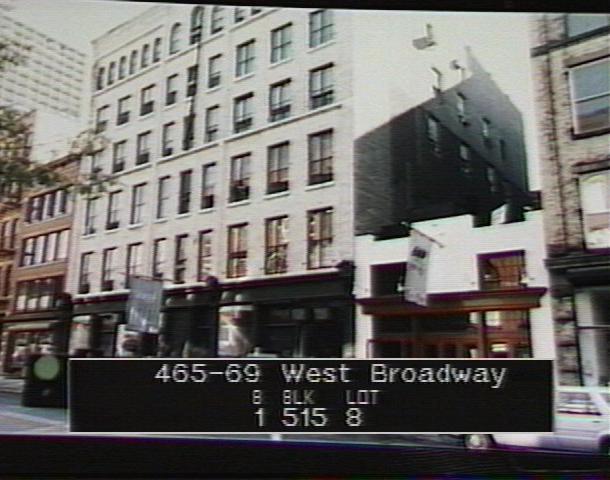
The city photographed every building for its tax records around 1940 and again in the 1980s. NYC Municipal Archives.
Written with AI from the source each entry cites, then fact-checked.
- 1887
Amos Eno buys three old brick dwellings on this site for $50,500
Before the loft building, three two-story brick dwellings with attics stood at 87, 89 and 91 South Fifth Avenue, as West Broadway was then called. The ground floor of No. 91 held Paul Chichuzola's liquor saloon. Amos Eno bought them in 1887 and 1888, paying $17,500 for No. 87 and $33,000 together for Nos. 89 and 91, then cleared them for a new factory.
Source: Daytonian in Manhattan
- 1890
John H. Whitenach's six-story, nine-bay building at 465-469 West Broadway is finished
Built in 1889-90, this six-story, nine-bay building has an iron storefront whose piers are decorated with neo-Grec foliage. Brick pilasters group the upper floors into three sets of three bays, and the roofline has a corbelled brick cornice and a triangular pediment. Architect John H. Whitenach had designed a very similar building at 457-461 West Broadway a year earlier, with a simpler storefront and a similar pediment.
“The brick facade of the upper stories is divided into three groups of three bays each by brick pilasters.”
- 1894
About 200 shoe workers strike J. J. Lattemann, and a fire follows on April 2
The J. J. Lattemann Shoe Manufacturing Company had more than 200 workers on the building's upper three floors in 1894. On February 20 they walked out because the owner would not fire four non-union employees. Pickets confronted the replacement workers, and early on April 2 a fire damaged the fifth floor; arson was suspected but never proved. The strikers conceded defeat and the factory ran without a union.
Source: Daytonian in Manhattan
- 1904
The Moxie Nerve Food plant is operating here by 1904
Moxie began in Lowell, Massachusetts, in 1876, when Dr. Augustin Thompson mixed a gentian tonic and sold it as a cure for nervous exhaustion and other ailments. By 1904 its plant had moved into this West Broadway building. Thompson's marketing put the name on glassware, trays, delivery wagons and lampshades, and the word moxie came to mean spunk or courage in American speech.
Source: Daytonian in Manhattan
- 1969
Ivan Karp opens the OK Harris Gallery in two huge ground-floor spaces
Ivan Karp opened the OK Harris Gallery here in October 1969. New York magazine described two huge ground-floor galleries and said Karp now had the space to show young artists he had discovered. The building went on to draw other galleries, including Star Gallery in 1974 and Ergane Gallery in 1992. The OK Harris archive, covering 1960 to 2014, went to the Smithsonian's Archives of American Art in 2015.
Source: Daytonian in Manhattan
Nearby
- 463 West Broadway1 entry
- 471 West Broadway1 entry
- 149 Wooster Street1 entry
- 473 West Broadway1 entry
- 147 Wooster Street4 entries
- 459 West Broadway4 entries