48 3rd Avenue
also 95 East 10th Street | East Village | built 1900
Open on the map4 entries

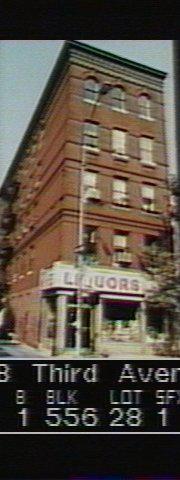
The city photographed every building for its tax records around 1940 and again in the 1980s. NYC Municipal Archives.
Written with AI from the source each entry cites, then fact-checked.
- 1886
James Farnsworth designs a tenement for the Thorne estate
Architect James M. Farnsworth designed the five-story brick tenement for trustees of the Eliza L. White estate, including Samuel Thorne, a Pennsylvania Coal Company president with ties to the Vanderbilts, at a cost of $15,000. Its ornate iron fire escapes along East 10th Street were later described as more reminiscent of New Orleans than New York.
- 1937
Berenice Abbott photographs the corner's row of storefronts
Photographer Berenice Abbott captured the building in her 1937 image "Pawn Shop, 48 Third Avenue," documenting a colorful commercial row that included the Stuyvesant Curiosity Shop, a neighboring pawnbroker, and Sigmund Klein's Fat Men's Shop. The tenement is the only one of that row of seven buildings still standing; the other six were later demolished.
Source: Ephemeral New York
- 1956
Painter Raymond Spillenger moves into the building
Abstract Expressionist painter Raymond P. Spillenger, who had studied under Josef Albers and Willem de Kooning, moved into the building with his wife Marion Dennison Katz in 1956 and remained until his death in 2013. He became known as one of the last surviving first- and second-generation Abstract Expressionists.
Source: Daytonian in Manhattan
- 1957
Boris Lurie opens the March Gallery in the ground-floor storefront
Painter Boris Lurie ran the March Gallery in the building's East 10th Street storefront from 1957 to 1960, showing experimental and emerging artists. In 1960 he used the gallery to help found the NO!art movement, a reaction against both Abstract Expressionism and Pop Art.
Further reading
- James M. Farnworth's 1886 95 East 10th StreetDaytonian in Manhattan
- 48 Third Avenue; 91-99 East 10th StreetVillage Preservation: East Village Building Blocks
- 50 Third Avenue; 50-52 Third AvenueVillage Preservation: East Village Building Blocks
- This East Village tenement is all that’s left of a row of colorful shops made famous by a 1937 photoEphemeral New York
Nearby
- 59 4th Avenue3 entries
- 102 East 10th Street4 entries
- 104 East 10th Street4 entries
- Amc Theatre Village66 3rd Avenue | 2 entries
- 106 East 10th Street3 entries
- Greenwich Arms85 4th Avenue | 2 entries