48 8th Avenue
West Village | built 1845
Open on the map5 entries

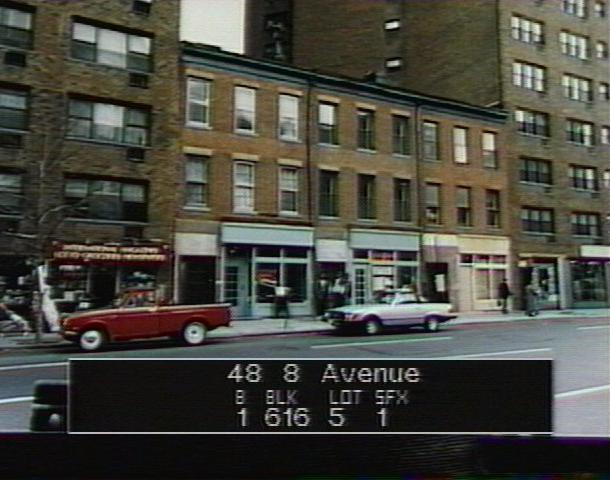
The city photographed every building for its tax records around 1940 and again in the 1980s. NYC Municipal Archives.
Written with AI from the source each entry cites, then fact-checked.
- 1845
Asher B. Hamlin builds a row of eleven shop-and-house buildings on Eighth Avenue
In the spring of 1845 Asher B. Hamlin of Islip bought this blockfront between Horatio and Jane Streets and put up eleven identical three-story houses, each with a store at street level and living space above. Only three of the eleven survive, and a single continuous roof cornice ties them together. Their ground floors were later opened into one restaurant space.
- 1857
Merchant Nelson D. Thayer lives above the shop and enters city politics
While real estate men Ross and Erving worked on the ground floor, the upper floors of No. 48 were rented to Nelson D. Thayer, a merchant born in Schenectady in 1818, and his family of six children. Thayer won election to the city assembly in 1857 and became a fire commissioner in 1859. The family stayed in the house into the 1860s.
Source: Daytonian in Manhattan
- 1906
The Staten Island Homes Company sells New Dorp Manor lots from No. 48
By 1906 the ground-floor shop at No. 48 had become the main office of the Staten Island Homes Company, which launched its New Dorp Manor development that year. Lots sold for $100 to $300, payable in monthly installments of $2 to $6. The company's pitch noted that Staten Island residents wanted subways and bridges to reach Manhattan faster.
Source: Daytonian in Manhattan
- 1950
The three shops are joined into the Sea Colony, a Mafia-owned lesbian bar and restaurant
Around 1950 the storefronts of Nos. 48 to 52 were opened up into one big room that became the Sea Colony Restaurant. It included a dance room where women could dance together, which was then illegal. The Mafia reportedly owned the business, as it did many gay bars of the time, and the police raided it routinely. The Sea Colony stayed in the space into the 1960s.
Source: Daytonian in Manhattan
- 1955
The Sea Colony ranks among the most popular lesbian bars in Greenwich Village
From about 1955 into the 1960s the Sea Colony drew mostly working-class women, even though the Mafia ran it and police raids were frequent. The main bar was at No. 52, a table-service dining room at No. 50, and a hidden back room at No. 48 where the banned dancing took place. Bartender Preston Mardenborough recalled that during raids everyone would run to the tables and pretend to be having drinks. Patrons who were arrested were taken to the Women's House of Detention nearby.
Source: NYC LGBT Historic Sites Project
Further reading
- Surprising Relics -- 48 to 52 Eighth AvenueDaytonian in Manhattan
- Then & Now photos: 48 Eighth AvenueVillage Preservation: Greenwich Village Then & Now
Nearby
- 50 8th Avenue3 entries
- 46 8th Avenue2 entries
- 52 8th Avenue1 entry
- 54 8th Avenue2 entries
- 41 8th Avenue1 entry
- 45 8th Avenue2 entries