48 Charles Street
also 142 7th Avenue South | West Village | built 1840
Open on the map5 entries

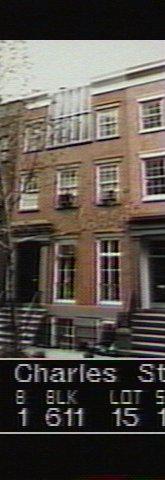
The city photographed every building for its tax records around 1940 and again in the 1980s. NYC Municipal Archives.
Written with AI from the source each entry cites, then fact-checked.
- 1839
Local builders erect five Greek Revival houses at 48-56 Charles Street
In 1839 a group of masons, smiths and builders cooperated to put up five Greek Revival houses at 48 through 56 Charles Street, each owned separately but sharing one set of plans. The easternmost, No. 48, was owned by the smiths Samuel Cyphers and Edward Duvall, who apparently built it for rental income. It is red brick with brownstone trim, 20 feet wide and three stories over an English basement.
Source: Daytonian in Manhattan
- 1852
Resident Henry Dingee bills the U.S. government for $1,554.25 in ordnance and supplies
Henry A. Dingee, who lived here with his family, ran a coach-making business and, with his brother Robert, a firm making military accessories for the U.S. Army. Henry took over the firm after Robert died in 1851. In 1863 his firm Dingee & Lorigan supplied the army with 18,550 carbine boxes and 20,000 carbine slings.
Source: Daytonian in Manhattan
- 1912
Stepping Stone House opens here as a halfway house for men sliding toward begging
On January 1, 1912, the house was leased to a national charity that opened Stepping Stone House there, the Association for the Prevention of Mendicancy and Charitable Imposture. The New-York Tribune described it as a temporary home for exceptional men who were losing their footing and drifting into mendicancy. The project was short-lived, and the owner then leased the house to artists.
Source: Daytonian in Manhattan
- 1921
Western painter Frank Tenney Johnson buys the house and works from the top-floor studio
After the artist Frank Tenney Johnson and H. Ledyard Towle converted the house to apartments, with a large studio window cut into the top floor, Johnson and his wife bought it. A year before buying, he had started traveling to the Far West, and he completed his sketches here. In March 1922 he and his wife hosted a group of New Jersey club women at the studio.
Source: Daytonian in Manhattan
- 1935
Police in gas masks rush an artist's studio and find only burning sulphur candles
Illustrator Florence Wilde, who taught from her studio in the house, was the subject of a New York Post item headlined "What, No Bodies?" Police wearing gas masks arrived at 1 A.M. to rescue several people reported overcome by gas fumes. They found nobody in trouble, only several lit sulphur candles and a pungent smell.
Source: Daytonian in Manhattan
Further reading
- The 1840 Charles H. Macy House - 48 Charles StreetDaytonian in Manhattan
- Then & Now photos: 48 Charles Street (aka 142 Seventh Avenue South)Village Preservation: Greenwich Village Then & Now
Nearby
- 50 Charles Street1 entry
- 46 Charles Street1 entry
- 52 Charles Street1 entry
- 54 Charles Street5 entries
- 56 Charles Street1 entry
- 58 Charles Street1 entry