Bank of New York Building
48 Wall Street | Financial District | built 1929
Open on the map12 entries

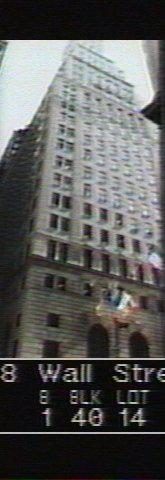
The city photographed every building for its tax records around 1940 and again in the 1980s. NYC Municipal Archives.
Written with AI from the source each entry cites, then fact-checked.
- 1798
The Bank of New York opens its first building on this corner
The Bank of New York, founded in 1784, moved from a Pearl Street mansion to Hanover Square in 1787. In 1796 its board voted to relocate to the corner of Wall and William Streets, at a cost of 10,000 New York pounds, and the new building, with vaults for the bank's business, opened on April 23, 1798. Several years later, 7 feet were trimmed off its William Street side when that street was widened.
Source: Wikipedia
- 1858
A second Bank of New York building replaces the first
In 1856 the Bank of New York approved plans by Vaux and Withers for a four-story brownstone and brick building at the corner, completed in 1858. Its banking room, with a 26-foot ceiling, sat at the rear on the first two floors. Two more stories, topped by a mansard roof, were added in 1880.
Source: Wikipedia
- 1922
The Bank of New York merges with the New York Life Insurance and Trust Company
In 1922 the Bank of New York combined with a fiduciary institution founded in 1830, the New York Life Insurance and Trust Company; the merged firm operated as the Bank of New York & Trust Company. It took over the trust company's four-story building at 52 Wall Street. By 1927 the bank had almost 300 employees and decided to put up a new skyscraper.
“In 1922, it expanded its business through a merger with the New York Life Insurance and Trust Company, a fiduciary institution founded in 1830…”
- 1926
The bank swaps 50 Wall Street for 52 Wall Street to assemble a corner lot
The Bank of New York & Trust Company reached an agreement in December 1926 to trade the 52 Wall Street property for 50 Wall Street, owned by the National City Company. The exchange gave the bank a corner lot measuring 99 feet along Wall Street and 125 feet along William Street. The deal was finalized in May 1927, when the bank filed plans for a 32-story tower by Benjamin Wistar Morris.
- 1928
Stones from two earlier bank buildings are built into the new tower
While Benjamin Wistar Morris's 32-story skyscraper was rising, bank officials held a ceremony in September 1928 to insert stones from the two earlier buildings on the site into its walls. The same month, a golden eagle was placed atop the roof, above a cupola designed in the Federal style.
Source: Wikipedia
- 1929
The law firm Sullivan & Cromwell leases four floors in the new tower
When the building opened in 1929, the Bank of New York & Trust Company took its first seven floors, with the public banking spaces on the lowest three. The law firm Sullivan & Cromwell leased four floors, alongside several brokerage and banking firms. Most of the major tenants managed to ride out the Depression.
“Other tenants included several brokerage and banking firms and the law firm of Sullivan & Cromwell which leased four floors.”
- 1929
The current 32-story bank building opens on Hamilton's birthday
The neo-Georgian skyscraper opened on January 12, 1929, the 172nd anniversary of Alexander Hamilton's birth, with all 32 floors leased. The Bank of New York used the first three floors for its banking room, trust department, and safe deposit boxes, and floors four through seven for offices. The law firm Sullivan & Cromwell took four floors upstairs.
Source: Wikipedia
- 1946
The bank buys the former Kuhn & Loeb headquarters next door at 52-54 William Street
The Bank of New York purchased the neighboring building at 52-54 William Street in August 1946; it was where the investment bank Kuhn & Loeb had earlier had its headquarters. Around the mid-1940s the bank, along with a number of its office tenants, was short of space. Over the next few years the two buildings were connected at several stories.
- 1988
The Bank of New York merges with Irving Trust and moves its headquarters to One Wall Street
In December 1988 the Bank of New York Company merged with the Irving Trust Bank Corporation. The bank then moved its corporate headquarters to the Irving Trust Building at 1 Wall Street.
- 1998
The Bank of New York leaves after 201 years on the site, and a developer buys the tower
The Landmarks report says 48 Wall Street was sold to Swig Burris Equities in February 1998. According to Wikipedia, a two-stage auction drew more than 20 bidders, and a joint venture of the Corsair Group and Swig Burris paid $37.5 million. The Bank of New York left in September 1998 after 201 years on the site. The new owners intended to turn the upper stories into 277 or 279 rental apartments.
Source: Wikipedia
- 2000
Owners cancel plans for apartments in the bank tower after demolition was well underway
Interior demolition for the apartment conversion was well underway when the owners began weighing a return to commercial use by January 2000. The next month they canceled the plan to add apartments, citing growing demand for office space from tenants willing to pay more per square foot. The building reopened in August 2001 as an office building that was 65 percent occupied.
“The next month, the owners canceled plans for adding apartments to the building. They cited the growing demand for commercial and office space…”
Source: Wikipedia
- 2007
The Museum of American Finance opens in the former banking hall
The Bank of New York left 48 Wall Street in 1998, and the building was then extensively renovated. From 2007 to 2018 the former banking hall housed the Museum of American Finance, and a multi-purpose event venue called Will & Wall took over the space afterward.
Source: Wikipedia
Further reading
- 48 Wall StreetWikipedia
Nearby
- Caledonian Insurance Building50 Pine Street | 5 entries
- Sun Fire Insurance Building54 Pine Street | 4 entries
- Our Lady of Victory Church60 William Street | 6 entries
- 60 Wall Street9 entries
- Cipriani Wall Street55 Wall Street | 13 entries
- The Wallace Building56 Pine Street | 4 entries